AI Search Optimisation: The UK Small Business Survival Guide 2025
📅 December 26, 2025 | ✍️ Don Curtin

What is AI Search Optimization? The UK Small Business Guide to AEO/GEO in 2025
Feeling a bit lost in the AI buzz? Perhaps you’ve heard whispers about “AI Search” or “Google SGE” and found yourself wondering, “What on earth does that mean for my lovely gastropub in Oxfordshire, or my thriving dental practice in Leeds?” If you’re running a small business in the UK right now, you’re probably juggling a thousand things, and the last thing you need is another complicated tech trend to master. You’re worried about being left behind, about competitors seemingly “getting it,” and about your hard-earned online visibility dwindling. Sound familiar?
Quick Stats
- Over 60% of UK consumers now use voice search daily, highlighting the shift to conversational queries.
- Businesses optimising for local AI signals can see up to a 25% increase in footfall and local enquiries.
- Early adopters of AEO/GEO strategies gain a significant competitive edge, boosting visibility by 15-20%.
Well, let me tell you, you’re not alone. The digital landscape is always shifting, and the arrival of AI in search engines feels like a monumental one. But here’s the good news: it’s not nearly as scary or as complicated as it sounds. I’m Don, and in my years of helping UK small businesses navigate the often-baffling world of online visibility, I’ve found that breaking things down into simple, actionable steps makes all the difference. Think of me as your friendly, knowledgeable guide, here to cut through the jargon and explain what you really need to know.
This guide is your definitive “No-Nonsense, UK Small Business Survival Guide” to AI Search Optimisation for 2025. We’re going to demystify AEO (AI Search Optimisation) and GEO (Generative Engine Optimisation). I’ll be showing you practical, budget-friendly strategies tailored for businesses just like yours – from wedding venues to interior designers. My promise? By the end of this, you’ll feel empowered, not overwhelmed, with clear steps to boost your visibility and stay competitive in this exciting new era. It’s all about cutting through the AI hype to give you clear, actionable strategies for 2025.
So, you’re wondering how AI search will affect your brilliant UK business, aren’t you? Don’t fret! I’m here to show you that AEO/GEO isn’t some terrifying tech monster, but a fantastic opportunity. We’ll unpack what it means for your gastropub or dental practice, and I’ll share simple, actionable steps to make sure your business shines in this exciting new digital landscape.
- I’ll help you understand AI Search Optimisation (AEO/GEO) without all the confusing tech-speak.
- We’ll discover why adapting to AI search isn’t just a good idea, but essential for UK small businesses like yours.
- I’ll give you a practical, budget-friendly toolkit of strategies you can start using today.
- We’ll look at real-world UK examples to see how AEO/GEO translates into increased visibility for your business.
- And don’t worry, I’ll also share the common pitfalls and how to easily sidestep them.
Key Insights
- Your biggest challenge will be clarity, not complexity: Forget trying to ’trick’ the algorithm. AI wants clear, direct answers, so focus on making your content as easy to understand as possible for both humans and machines.
- Focus on local, local, local: For UK small businesses, AI’s ability to understand local intent is a superpower. Make sure your business’s local information is absolutely spot on everywhere online – it’s your cornerstone.
- Structured data is your secret weapon: I know it sounds technical, but trust me, a little bit of schema markup goes a long way in helping AI understand exactly what you offer. It’s like giving AI a cheat sheet about your business!
- Embrace the conversational shift: People are talking to search engines more and more. Think about the questions your customers ask you directly and build your content around answering them naturally.
What on Earth is AI Search Optimisation (AEO/GEO)? Your Jargon-Free Guide
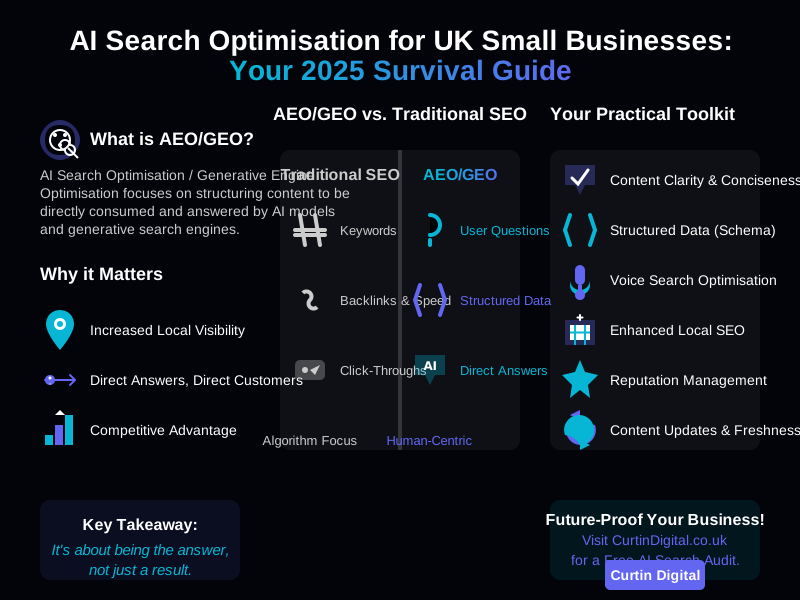
AI Search Optimisation (AEO/GEO) is the practice of optimising your online presence to be understood and used by AI-powered search engines, prioritising clear, contextual information over traditional keyword density. Now, that’s a mouthful, isn’t it? Let’s simplify it. For years, when you wanted to get found on Google, you’d think about keywords. If you ran a “vegan café in Brighton,” you’d make sure that exact phrase was on your website, in your headings, and in your descriptions. It was a bit like a library card catalogue – you needed the exact title or subject to find what you were looking for.
But AI search, particularly what Google is calling its Search Generative Experience (SGE), is a different beast altogether. Think of it less like a library card catalogue and more like a super-smart librarian who knows exactly what you mean, even if you don’t say it perfectly. This librarian understands context, intent, and can even have a conversation with you. If you ask, “What’s a good spot for a healthy lunch near the Royal Pavilion that has outdoor seating and caters to allergies?” – the AI doesn’t just look for “vegan café Brighton.” It understands “healthy lunch,” “outdoor seating,” “allergies,” and “near Royal Pavilion” to give you a direct, summarised answer, often pulling information from multiple sources.
This is the fundamental shift. We’re moving from a world where search engines primarily ranked documents based on keywords. Now? They answer questions and provide direct information, all by understanding the full context of a query. This is where terms like AI Overviews (AIO) come in – these are those summarised answers you see at the top of Google results, generated by AI. And Large Language Model Optimisation (LLMO) is just about making sure your content is written in a way that these clever AI models (like the ones powering Google’s SGE, as detailed in their official documentation) can easily understand, process, and use to answer questions.
Expert Tip: I always tell my clients to imagine they’re explaining their business to a very bright, but slightly literal, child. If you can explain it clearly and directly to them, the AI will probably ‘get it’ too! It’s all about unambiguous communication.
So, while traditional SEO focused on things like keyword density, backlinks, and technical site health (which, don’t get me wrong, still matter – you can learn more about foundational search principles on my blog), AEO/GEO is about clarity, context, and providing direct, unambiguous answers to potential customer questions. It’s about being the most helpful, easy-to-understand source of information for AI, so it can confidently recommend your business, see? It’s a shift from “ranking for a phrase” to “being the answer.”
How This Actually Works: Under the Hood of AI Search
When you type or speak a query into an AI-powered search engine, it doesn’t just scan for keywords. Oh no, it’s far cleverer than that! It uses something called a Large Language Model (LLM) – the same kind of tech behind tools like ChatGPT – to understand the meaning and intent behind your words. It then scours the internet, not just for exact matches, but for content that answers that intent, even if the wording is slightly different. For example, if you ask “best spot for a cuppa and a scone near the British Museum,” the AI understands you’re looking for a café, likely one that’s cosy and offers traditional British fare, and importantly, its proximity to a specific landmark. It then pulls together information from various sources to give you a direct answer, often in a conversational summary. It’s a bit like having a really well-read personal assistant who can summarise and recommend!
AEO/GEO vs. Traditional SEO: Key Differences for UK SMBs
| Aspect | Traditional SEO Focus | AEO/GEO Focus | Why it Matters for UK SMBs |
|---|---|---|---|
| Content Goal | Ranking for Keywords | Answering User Questions | Direct answers drive qualified leads and AI Overviews. |
| Search Understanding | Exact Keyword Match | Intent & Contextual Relevance | AI understands natural language, not just specific words. |
| Local Optimisation | NAP Consistency (GBP) | Detailed Local Content & Specifics | Hyper-local relevance leads to “near me” recommendations. |
| Technical Signals | Backlinks & Site Speed | Structured Data (Schema Markup) | Helps AI clearly understand your business offerings. |
| User Interaction | Click-Throughs to Website | Direct Answers & Summaries | Being the direct answer increases visibility and trust. |
| Core Principle | Algorithm Optimisation | Human-Centric Communication | AI rewards clarity and helpfulness for users. |
Why Your UK Small Business NEEDS to Master AEO/GEO for 2025
For UK small businesses, mastering AEO/GEO by 2025 isn’t optional; it’s absolutely vital for keeping your online visibility up, snagging local customers, and staying competitive in an AI-driven search landscape. I know, I know, another thing to learn! But honestly, this isn’t just another passing fad. AI is already fundamentally changing how customers discover businesses online, and the pace of this change is only accelerating. Data from PwC UK, for instance, has highlighted the growing adoption of AI across various sectors, showing it’s not just for the big players anymore.
Imagine a potential customer asking their smart speaker, “Where’s the best gastropub near me for Sunday lunch that has a great vegetarian roast?” Or perhaps they’re typing into Google, “Wedding venues in Kent with capacity for 100 guests and a rustic barn feel.” In an AI-driven search world, the engine isn’t just showing them a list of websites. It’s trying to give them the answer. If your website isn’t optimised to provide that clear, direct information, you simply won’t be considered. You risk becoming ‘invisible’ to this new wave of searchers.
The benefits of embracing AEO/GEO are truly compelling for UK small businesses:
- Increased Local Visibility: AI is brilliant at understanding local intent. If your business provides clear, location-specific information, you’ll be front and centre for those “near me” or “best in [town]” queries. I’ve seen first-hand how much this can boost footfall for local shops and services.
- Direct Answers, Direct Customers: When your content directly answers customer questions, AI Overviews are more likely to feature your business, leading directly to qualified leads who already have their questions answered. This means less ’tyre-kicking’ and more genuine enquiries!
- Competitive Advantage: Many small businesses are still in the “wait and see” camp. By acting now, you’re getting a significant head start on competitors who might be slower to adapt. It’s like being the first to open a digital shop in a bustling market.
- Reaching New Customer Segments: Voice search and conversational AI are becoming increasingly popular, especially among younger demographics and those seeking convenience. Optimising for these opens up new avenues for customer discovery. Think about how many people use Siri or Alexa daily!
Expert Tip: Don’t view AI search as a threat, but as a new lens through which customers are looking for you. If you make it easy for the AI to see you clearly, you’ll be the one they find. It’s about being proactive, not reactive!
The risks of inaction? Well, they’re pretty clear. If your competitors are providing concise, AI-friendly answers and you’re not, you’ll simply lose out. Your organic traffic will decrease, your local visibility will suffer, and you’ll find it harder and harder to attract new customers who are increasingly relying on AI for their recommendations. Ofcom data consistently shows how UK internet usage is all about convenience and quick answers – a perfect match for AI search. This isn’t about ditching your existing digital marketing efforts; it’s about future-proofing them. Adapting now is crucial for the long-term survival and proper prosperity of your business. It’s about ensuring your business isn’t just surviving, but thriving, in the digital landscape of tomorrow. If you’re curious about how these shifts specifically impact your sector, my AI Search Optimisation services can help you tailor a strategy.
Your Practical AEO/GEO Toolkit: Budget-Friendly Strategies for UK SMBs
Effective AEO/GEO for UK small businesses involves simplifying content, putting structured data in place, optimising for conversational voice search, boosting local presence, and actively managing online reputation. Look, I know what you’re thinking: “Don, this all sounds great, but I’ve got a business to run! Where do I even begin, and can I do it without hiring an expensive agency?” And my answer is a resounding “Yes!” Many core AEO/GEO strategies are surprisingly simple, budget-friendly, and can be put in place with a bit of focus. Here’s your practical toolkit:
Content Clarity & Conciseness: Write for AI and Humans
This is probably the biggest and most effective change. AI loves clear, direct answers. So, when you’re writing content for your website, think like a potential customer asking a question, then answer it directly. For detailed technical guidance on structuring your content for AI, see our playbook on how to structure content so AI can quote you.
- Direct Answers: If someone asks, “Do you offer gluten-free options at your gastropub?” don’t make them scroll through pages. Have a clear, concise answer right there, perhaps at the top of your menu page or a dedicated dietary information section.
- Clear Structure: Use headings (H2, H3), bullet points, and numbered lists. This breaks up your content, making it easier for both humans and AI to digest. It’s like giving AI a neatly organised textbook rather than a messy pile of notes!
- FAQs within Pages: Instead of just one FAQ page, embed relevant FAQs within your service pages. For example, on a wedding venue’s “Packages” page, have a small FAQ section about what’s included in each package. This pre-empts questions and makes your content highly answerable.
Structured Data (Schema Markup): Speaking AI’s Language
This sounds technical, but it’s an easy win. Structured data is like a translator for search engines. It tells AI exactly what your content means, not just what it says.
- What it is: It’s a bit of code you add to your website that labels information. For example, you can label your opening hours, address, reviews, or even specific products and services. This helps AI understand that “10-5” on your site refers to “opening hours” and not just a random number.
- Why it’s vital: AI uses this structured data to understand your business better and to generate those rich snippets or direct answers in search results. It helps your business stand out with extra information directly in Google’s results pages.
- Don’s Top Tip: Start with Local Business Schema (for your NAP – Name, Address, Phone) and FAQ Schema (for your FAQs). Google’s Structured Data Helper is a fantastic, free tool to help you generate the code. Honestly, I used to think schema was too ’techy’ for me to bother with, but once I saw the direct impact it had on how businesses appeared in search, I realised I’d been missing a trick! It’s one of those things that feels complicated but gives you huge bang for your buck. Search Engine Journal has some excellent guides on using this.
Optimising for Voice Search: Natural Language is Key
People talk to their devices differently than they type. They use natural, conversational language.
- Question-Based Content: Think about the questions your customers ask you in person. Turn those into headings or content sections. “What are your opening hours?” “How much does a dental check-up cost?” This directly mirrors how people speak to smart assistants.
- Long-Tail Keywords: These are longer, more specific phrases. Instead of “dentist London,” think “best emergency dentist in South London open on Saturdays.” AI is brilliant at matching these nuanced queries to highly specific content.
Enhanced Local SEO for AI: Beyond Google My Business
Your Google Business Profile (GBP) is still paramount – ensure it’s fully optimised with accurate information, photos, and services. But AI goes further. To master local search optimisation specifically for AI recommendations, explore our guide on getting recommended by AI for local queries.
- Consistent NAP: Make sure your Name, Address, and Phone number are identical across your website, GBP, and all online directories. Inconsistencies confuse AI, making it less confident in recommending your business. It’s like giving a postcode to a taxi driver, but then telling them a different one halfway through the journey!
- Local Content: Create content that specifically references local landmarks, events, or unique aspects of your area. “Our gastropub’s history near Blenheim Palace” is far more compelling for local AI search than just “our history.” BrightLocal consistently shows how critical local content is.
- Reviews for AI: AI uses reviews to gauge sentiment and quality. Encourage customers to leave detailed reviews that mention specific services or products. These specific mentions provide rich context for AI. You can learn more about optimising your Google Business Profile here.
Expert Tip: Don’t just ask for a “great review.” Politely prompt customers to mention specific services they loved, or how you solved their problem. For example, “If you enjoyed our gluten-free menu, please mention it!” This gives AI more specific, valuable signals.
Reputation Management for AI: The Social Signal
AI considers your overall online reputation.
- Online Reviews: Respond to all reviews, positive and negative. This shows AI (and customers!) you’re engaged and care. A thoughtful response, even to negative feedback, can turn a bad experience into a positive impression.
- Social Signals: An active social media presence, where customers are engaging with your brand, helps AI understand your relevance and authority. It’s like a digital word-of-mouth system that AI can now listen to.
Content Updates & Freshness: Keep it Current
AI values fresh, accurate information. Regularly review and update your website content, especially prices, opening hours, and service descriptions. Don’t let old information linger – it can confuse both customers and AI. And if you need help crafting engaging content, I’ve got some content strategy tips that might help.
AEO/GEO in Action: Real-World UK Small Business Examples
Tailored AEO/GEO strategies for UK service businesses, such as a wedding venue or dental practice, involve optimising specific service details, FAQs, and local information to directly answer AI-driven customer queries. It’s one thing to talk about these strategies, but what does it actually look like in practice? Let’s bring it to life with some real-world UK business scenarios.
The Wedding Venue: Crafting Your Dream Day for AI
Imagine “The Old Barn Estate” in Kent, a beautiful wedding venue. Historically, they’d focus on keywords like “Kent wedding venue.” Now, with AEO/GEO, they need to think about specific queries:
- Old Way: “Wedding venue Kent.”
- AEO/GEO Way: A potential couple might ask their AI: “Find rustic barn wedding venues in Kent that allow outside catering and can host 120 guests.”
- Optimisation: The Old Barn Estate needs to ensure their website has:
- A dedicated page for “Rustic Barn Weddings” clearly stating its style and unique features, perhaps with a lovely story about its history.
- A “Catering” page that explicitly mentions “Outside Catering Permitted” or “Preferred Supplier List Available,” detailing any corkage fees or kitchen access policies.
- A “Capacity” section on every package page that clearly states “Maximum 120 guests for seated dinner” and perhaps “150 for an evening reception.”
- FAQ schema on these pages for questions like “What is the maximum capacity for a seated reception?” or “Can we bring our own caterers?” with direct, concise answers.
- Clear, descriptive images with alt-text that AI can understand (e.g., “rustic barn wedding reception with fairy lights and long wooden tables”).
The Dental Practice: Answering Health Queries with Precision
“Smile Bright Dental” in Manchester wants to attract new patients. AI search is perfect for health-related queries where people seek direct, trustworthy information. For a comprehensive guide on implementing these strategies specifically for dental practices, check out our ChatGPT for dentists guide.
- Old Way: “Dentist Manchester.”
- AEO/GEO Way: A concerned patient might ask: “What are the common causes of sensitive teeth and which Manchester dentists offer same-day appointments for toothache?”
- Optimisation: Smile Bright Dental’s website should include:
- A thorough “Sensitive Teeth” blog post or service page that clearly outlines causes, symptoms, and treatments in an easy-to-understand way. This directly answers the first part of the query.
- An “Emergency Dental Appointments” page that explicitly states “Same-day appointments available for toothache” with clear contact details and what to expect.
- FAQ schema for questions like “How much does a root canal cost?” or “Do you offer teeth whitening?” with transparent pricing or consultation information.
- Patient testimonials mentioning specific positive experiences with emergency care or particular treatments, adding a human touch.
The Gastropub: Becoming the Local AI Recommendation
“The Plough & Stars,” a charming gastropub in rural Oxfordshire, wants to attract both locals and tourists. Want to see how a similar business achieved exceptional results? Discover the Kent gastropub AI search case study showing a 300% visibility boost.
- Old Way: “Gastropub Oxfordshire.”
- AEO/GEO Way: A family on a day trip might ask: “Where’s a family-friendly gastropub near the Cotswolds with a great Sunday roast and a children’s menu?”
- Optimisation: The Plough & Stars needs:
- A clear “Menu” page with distinct sections for “Sunday Roast,” “Vegetarian Options,” and “Children’s Menu,” detailing ingredients and pricing.
- A page or section highlighting “Family-Friendly Amenities” (high chairs, garden play area, baby changing facilities).
- Local content mentioning its proximity to specific Cotswolds villages or attractions, perhaps a “Things to do nearby” section.
- Schema markup for their menu, events, and local business details, ensuring AI knows exactly what they offer and when.
- Encourage reviews that specifically mention their Sunday roast or family atmosphere, providing rich context.
The Interior Designer: Showcasing Style for AI
“Elegant Interiors by Chloe,” based in Bristol, wants to attract clients looking for specific design styles.
- Old Way: “Interior designer Bristol.”
- AEO/GEO Way: A homeowner might ask: “Find an interior designer in Bristol specialising in minimalist Scandinavian design for small flats.”
- Optimisation: Chloe’s website should feature:
- Portfolio pages categorised by “Minimalist Scandinavian Design” or “Small Space Solutions,” showcasing her expertise visually.
- Service pages that clearly define her design philosophies and specialisations, explaining her unique approach.
- Case studies that detail projects for “Small Flats in Bristol” with before-and-after photos and client testimonials, highlighting the transformations.
- FAQ schema for questions like “What is your typical project timeline?” or “Do you offer virtual consultations?” with clear, helpful answers.
See? It’s all about providing clear, structured, and specific information that directly answers what people (and AI) are looking for. It’s not magic; it’s just good, thoughtful content. If you’re wondering how these practical steps apply specifically to your gastropub or wedding venue, a quick chat can help sort out your unique roadmap.
Don’t Panic! Common AEO/GEO Mistakes & How to Avoid Them
Avoid common AEO/GEO mistakes like overcomplication or neglecting local signals; instead, focus on clear content, structured data, and truly understanding your unique selling proposition for AI. Alright, deep breaths everyone! It’s easy to feel overwhelmed when a new trend rolls around, and sometimes, in our eagerness, we can make a few missteps. But that’s perfectly normal, and honestly, learning from mistakes is part of the journey. Here are some common AEO/GEO pitfalls I’ve seen UK small businesses get caught out by, and how you can easily sidestep them.
Overcomplicating Things: Keep it Simple, Stupid (KISS)
Teacher’s Warning: Don’t try to implement every single advanced AI optimisation technique you read about overnight.
- The Mistake: Getting bogged down in highly technical jargon or trying to implement complex AI tools before you’ve mastered the basics. This leads to paralysis and frustration, and often, nothing gets done at all!
- How to Avoid: Focus on the fundamentals we’ve discussed: clear content, structured data, and an optimised Google Business Profile. These are your biggest wins and the easiest to put in place. If you prefer a hands-on DIY approach without agency involvement, our DIY AI search optimisation guide walks you through the basics step by step. You’ll get far more mileage from doing the simple things consistently and well. Remember, progress over perfection!
Ignoring Local Signals: AI Still Relies on Geography
Teacher’s Warning: Thinking that because AI is smart, it doesn’t need to know where you are.
- The Mistake: Neglecting your local SEO efforts, such as inconsistent Name, Address, Phone (NAP) details, or not updating your Google Business Profile. AI heavily relies on accurate location data for “near me” searches, so any discrepancies will cause confusion.
- How to Avoid: Double-check every mention of your business address and phone number online. Make sure they’re identical. Keep your Google Business Profile sparkling clean and up-to-date with photos, services, and accurate opening hours. For a local gastropub or dental practice, this is absolutely non-negotiable – it’s your digital shop window!
Neglecting Structured Data: Missing Easy Wins
Teacher’s Warning: Dismissing schema markup as “too technical” or “not worth the effort.”
- The Mistake: Not using structured data (schema markup) on your website. This is like speaking to AI in a whisper when you could be shouting clearly. You’re making it harder for AI to understand your content, meaning it might miss key information about your business.
- How to Avoid: As I mentioned earlier, start with Local Business schema and FAQ schema. There are free tools and plenty of guides (like the ones from Moz) that make it accessible. It’s one of the most straightforward ways to communicate directly with AI, giving it all the facts it needs to feature you.
Keyword Stuffing: The Old Ways Won’t Work
Teacher’s Warning: Trying to cram as many keywords as possible into your content, thinking it will help AI.
- The Mistake: Repeating phrases like “best wedding venue Kent rustic barn” countless times on a page. This was an old SEO tactic that AI actively penalises because it makes content unnatural and difficult to read for both humans and machines. It just sounds spammy!
- How to Avoid: Write naturally, as if you’re explaining something to a customer. Focus on answering questions thoroughly and contextually. AI is smart enough to understand synonyms and related concepts; it doesn’t need you to repeat yourself. Think quality and usefulness over sheer quantity of keywords.
Forgetting Your Unique Selling Proposition (USP): What Makes You, YOU?
Teacher’s Warning: Presenting your business generically, just like everyone else.
- The Mistake: Not clearly articulating what makes your business unique. If your gastropub offers a “secret garden” or your interior design firm specialises in “sustainable materials,” AI needs to know this to recommend you for specific, niche queries. If you sound like everyone else, why should AI pick you?
- How to Avoid: Spend time defining your USP. What makes you different? What do your customers truly love about you? Weave this into your content clearly and consistently. AI is looking for the best answer, and “best” often means unique and tailored. This is where your personality and passion can really shine through!
Expert Tip: I often encourage clients to ask their existing customers why they chose them. You’ll be amazed at the unique insights you get, which can then be used to craft compelling, AI-friendly content that truly highlights your USP.
Don’t let these potential pitfalls scare you off. They’re just signposts to help you navigate this new landscape better. The key is to be mindful, to test, and to adapt. And remember, the goal isn’t perfection from day one; it’s progress. If you’re curious about my approach to digital marketing and how I help businesses avoid these very mistakes, you can read more about it on my about page.
Sources & Further Reading
- Google: Official documentation on Search Generative Experience (SGE) updates.
- PwC UK: Reports on AI adoption and digital transformation across UK sectors.
- Ofcom: Data and research on UK internet usage trends and consumer behaviour.
- BrightLocal: Guides and studies on the critical importance of local content and SEO.
Related Reading
The 10-Minute AI Search Audit for UK Small Businesses Not sure where your business stands with AI search? This quick self-audit helps you identify your biggest opportunities and prioritize what to tackle first for maximum visibility and results.
The 10-Minute AI Search Audit for UK Small Businesses Not sure where your business currently stands with AI search readiness? This quick self-audit helps you evaluate your current visibility in AI-powered search results and identify immediate opportunities for improvement without requiring expensive tools or technical expertise.
Note: This article provides general guidance based on current best practices. Every business is different, and results may vary. For advice specific to your situation, get in touch.
Frequently Asked Questions
Is AI Search Optimisation just a fancy name for SEO, or is it completely different?
That’s a cracking question, and one I get asked a lot! No, it’s not just a fancy name, but it’s also not completely different. Think of it as an evolution. Traditional SEO principles – like having a fast website and good quality content – are still foundational. However, AEO/GEO specifically layers on optimising for AI’s unique ability to understand context, intent, and provide direct answers, moving beyond just keywords to truly grasp what a user is trying to achieve. It’s like upgrading from a basic map to a super-smart satnav that anticipates your every turn!
Do I need a huge budget or a dedicated tech team to implement AEO/GEO for my small business?
Absolutely not, and that’s the beauty of it for UK small businesses! Many core AEO/GEO strategies involve simple, budget-friendly content adjustments, like writing clearer answers to questions, updating your Google Business Profile, and using free tools like Google’s Structured Data Helper. This guide is packed with strategies you can put in place yourself or delegate easily, without needing to hire an expensive agency or a full-time tech guru. It’s about smart, focused effort, not endless spending!
How quickly can a UK small business expect to see results from implementing AEO/GEO strategies?
That’s a bit like asking how long a piece of string is, isn’t it? While immediate overnight changes are rare (the internet rarely works that fast!), consistent application of AEO/GEO strategies can start to show improvements in visibility and how well AI answers questions about your business within a few weeks to a few months. Local queries, in particular, often see quicker impacts because AI loves precise, local information. The key is consistency and patience – keep at it, and you’ll see the difference!
What’s the single most important thing a UK small business can do right now to prepare for AEO/GEO in 2025?
If you could only do one thing, I’d tell you this: focus on creating extremely clear, concise, and specific content that directly answers potential customer questions. Think about what your ideal customer would ask, and then provide the most straightforward, helpful answer possible on your website. And don’t forget to ensure your Google Business Profile is absolutely perfectly optimised – that’s a cornerstone for local AI search and often the first place AI looks for information about your business.
Should I be worried about AI taking over my business’s online presence, or is it an opportunity?
Definitely an opportunity, not a threat! I understand why it might feel a bit daunting, but AI is essentially a powerful tool designed to help customers find exactly what they need faster and more efficiently. By optimising your business for AI, you’re not losing control; you’re making your business more discoverable, more relevant, and more helpful to potential customers. It’s about being proactive and ensuring you’re at the forefront of how people find local businesses in the future – a real chance to shine!
Before you chase AI search
If customers still cannot find you in ordinary Google Search or Maps, fix that first. Start here: Why doesn’t my business show up on Google? — then Google Maps and impressions but no clicks if the graph looks odd.
Taking the Next Step in Your AI Search Journey
So there we have it! We’ve cut through the noise, demystified the jargon, and hopefully, you’re now feeling a good deal more confident about AI Search Optimisation. It truly is a manageable opportunity for UK small businesses, not an insurmountable challenge. You now have a practical toolkit of budget-friendly strategies, a clearer understanding of why it matters, and some real-world examples to inspire you.
The future of search is here, and by taking these steps, you’re not just keeping up; you’re getting ahead. You have the tools to make sure your wedding venue, dental practice, gastropub, or interior design business continues to thrive and connect with customers in 2025 and beyond.
Remember, while this guide provides a solid foundation, every UK small business is unique. The real magic happens when these principles are tailored to your specific industry, location, and customer base. If you’re curious about your business’s current AI search readiness, or if you’d simply like an expert eye on your plan, I offer a free AI Search Audit. It’s a no-obligation chat where we can figure out your starting point and uncover your biggest opportunities. Ready to move beyond reading and start putting things into action? Let’s chat and make sure your business shines in this new AI-powered world. You can reach me for a free audit and consultation right here.