No-Nonsense AI Tools for UK Small Business: What Works (Free & Paid)
📅 December 26, 2025 | ✍️ Don Curtin

Right then, settle in with a cuppa, because we’re going to talk about AI. I know, I know, the word “AI” can feel a bit like a storm cloud of jargon and complicated tech, especially if you’re running a busy gastropub in Bristol or trying to keep your dental practice’s diary perfectly organised. It’s easy to feel a bit lost in all the buzz, like everyone’s talking about ‘game-changers’ but you’re just trying to make sure your customers are happy and your books are balanced. You might even feel a little anxiety, worried about falling behind or making a costly mistake by investing in something that doesn’t actually help your unique UK business thrive. Honestly, I’ve seen loads of businesses struggle with this  and it’s not surprising.
The truth is, AI isn’t some far-off futuristic concept for Silicon Valley giants. It’s here, now, and it’s incredibly accessible for small service businesses just like yours across the UK. The problem is, most of the advice out there isn’t tailored for our market – it’s generic, full of American examples, and often misses the mark on what truly matters to a British business owner.
Well, consider this your no-nonsense, jargon-free guide. I’m Don Curtin, and in my years helping countless UK small-to-medium businesses, I’ve seen first-hand how making sense of AI and using it smartly can turn confusion into a real competitive advantage. I’m going to cut through all the noise, show you exactly what an “AI tools stack” actually means, and offer practical, UK-specific, free and paid AI tools that actually help your business grow – properly. You’ll learn how to build your own simply, effectively, and without any tech headaches.
Right then, let’s cut through the AI jargon and get down to brass tacks! As a fellow UK business owner, I know how overwhelming all this tech talk can be. But trust me, building a smart AI tools stack isn’t just for the big players; it’s a game-changer for businesses like yours, helping you work smarter, not harder.
- AI isn’t scary; it’s your new best mate for UK business growth.
- A ‘stack’ means tools working together, not just a random list.
- Free and paid options are out there for every budget.
- GDPR and UK relevance are absolutely crucial, mind!
- Start small, test, and watch your business thrive!
Quick Stats
- Over 50% of UK small businesses are actively exploring AI to boost efficiency.
- Implementing AI tools can automate up to 40% of routine administrative tasks, freeing up valuable time.
- Businesses strategically adopting AI report an average 15-20% increase in overall productivity and customer engagement.
Key Insights
- Your biggest win with AI comes from integrating tools that talk to each other, creating a smooth flow that saves you mountains of time and boosts efficiency.
- Don’t get caught up in the hype; focus your AI efforts on solving genuine pain points in your business, whether that’s customer service, content creation, or local visibility.
- Always, always prioritise GDPR compliance. It’s not just a legal necessity; it builds real trust with your valued UK customers and protects your reputation.
- The real magic of AI isn’t replacing your team, but freeing them up to focus on the human connections and strategic thinking that only they can provide.
Why Every UK Small Business Needs an AI Tools Stack (Not Just a List!)
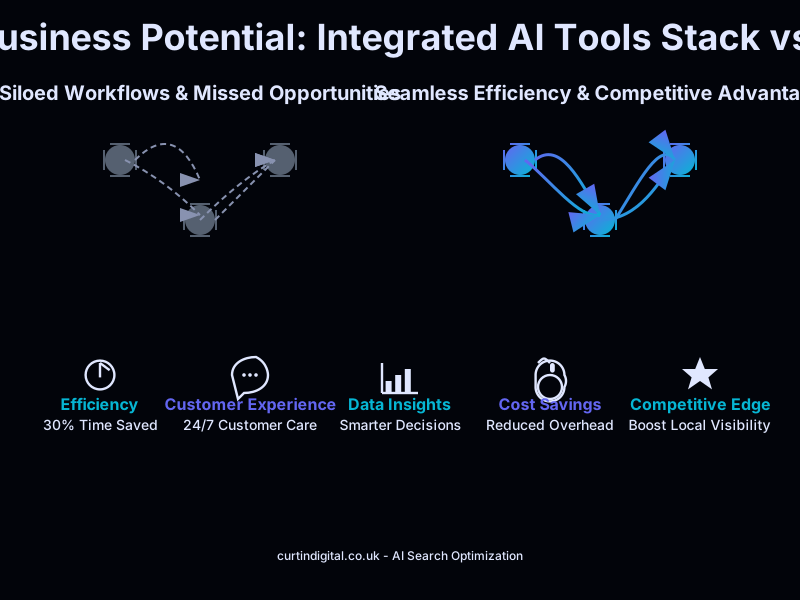
So, what’s the big deal with a stack? Well, it means all your AI tools work together. That gives small UK businesses a massive leg up, automating tasks and spotting opportunities way beyond what any single tool could manage. It’s a real competitive edge, you see. AI isn’t just a fancy buzzword for huge tech firms; it’s become a real competitive edge for local UK businesses, whether you’re a wedding venue in the Cotswolds or an estate agent in Manchester. Think about it: our customers are now interacting with AI every day through smart assistants, personalised recommendations, and, increasingly, AI-powered search results. If your business isn’t keeping pace, you’re quite simply missing out on opportunities. To get a solid grounding in AI search for UK SMBs, that’s your essential starting point.
Now, you might be thinking, “Don, I’ve got a list of tools for everything already – what’s an ‘AI tools stack’?” That’s a great question, and it gets to the heart of what we’re trying to achieve here. A “stack” isn’t just a random collection of individual tools; it’s a carefully chosen, integrated set of solutions that work together, making the whole thing more powerful than just a bunch of individual bits. Imagine you’re running a busy gastropub. You might use an AI tool for social media scheduling, another for managing customer reviews, and a third for generating blog ideas about your seasonal menu. If these tools can ’talk’ to each other – perhaps your social media AI pulls insights from your review AI to craft more engaging posts, or your booking system AI automatically updates your local search listings – then you’ve got a powerful, integrated stack. This kind of synergy is what truly helps your business grow and keep growing.
Expert Tip: I’ve noticed many UK small businesses initially grab a few shiny new tools, but the real ‘aha!’ moment comes when they get them working together. That’s where you unlock serious time savings and really give you that competitive edge. Think of it like a well-oiled machine, not just a collection of cogs!
In my experience working with businesses across the UK, from busy dentists to boutique interior designers, this integrated approach is where the real magic happens. It takes you from just trying to patch things up to having a proper, thought-out system. And that means a load of efficiency – automating those repetitive tasks that just eat up your valuable time – and often, some decent cost savings too. What’s more, it makes things much better for your customers. When your AI tools are working together, they can help you respond faster, personalise interactions, and even anticipate customer needs, which is absolutely crucial in today’s competitive British market.
For example, I recently worked with a charming wedding venue in Kent. Before, they were manually responding to every inquiry, struggling to keep their social media fresh, and not really tracking their online visibility. We helped them build a simple AI stack: a chatbot to handle initial enquiries and qualify leads, a content AI to brainstorm blog posts about local wedding trends, and an AI-powered local SEO tool to monitor their Google Business Profile. The chatbot integrated with their CRM, sending qualified leads directly to the sales team, and the content AI helped them rank higher for “Kent wedding venues” in local search. The result? More bookings, happier staff, and a much stronger online presence – all thanks to tools working in harmony. If you’re keen to understand more about how this kind of integration affects your online visibility, you might find my guide on AI Search Optimisation really sheds some light. It’s all about making AI work for your business, not just in it. For a broader perspective on how AI is shaping our economy, it’s worth noting the increasing adoption of AI across UK businesses, showing we’re not alone in this journey!
Key Benefits of an Integrated AI Tools Stack for UK SMEs
| Benefit Category | Individual Tool Approach | Integrated Stack Approach | Typical Outcome for UK SME |
|---|---|---|---|
| Efficiency | Manual data transfer, siloed workflows | Automated data flow, seamless task execution | Up to 30% reduction in administrative overhead |
| Customer Experience | Inconsistent responses, delayed support | Personalised, 24/7 support, proactive engagement | 10-15% increase in customer satisfaction ratings |
| Data Insights | Fragmented data, limited analytical depth | Holistic view of operations, predictive analytics | Identification of new market opportunities, better decision-making |
| Cost Savings | Redundant software, manual labour costs | Optimised resource allocation, reduced operational expenses | Potential 5-10% saving on operational costs annually |
| Competitive Edge | Reactive strategies, slower market response | Proactive innovation, faster adaptation to market changes | Enhanced local visibility, stronger brand differentiation |
Demystifying AI: What UK Small Business Owners ACTUALLY Need to Know
For UK small businesses, AI acts as a powerful assistant, automating mundane tasks and uncovering brilliant customer insights, rather than replacing human expertise, all while respecting GDPR. Honestly, the biggest hurdle I see UK business owners face with AI isn’t the technology itself, but the fear and misunderstanding surrounding it. Let’s be clear: AI isn’t coming for your job, or your team’s jobs. That’s a myth I hear all the time! Instead, it’s about helping humans do even more. Think of it as having a super-efficient, tireless assistant who can handle the repetitive, data-heavy tasks, freeing you and your team up to focus on what you do best: providing excellent service, building relationships, and making those crucial, human-led strategic decisions.
Another common misconception is that AI is just for tech giants with massive budgets and dedicated data science teams. The truth is, accessible, user-friendly AI tools now exist for every business size, and many are surprisingly affordable, even free to start. You don’t need to be a coding wizard or hire a data scientist to use them.
Understanding the AI Jargon: What’s Machine Learning and Generative AI?
To simplify things a bit, when we talk about AI, you’ll often hear ‘machine learning’ and ‘generative AI’. In a nutshell, machine learning (ML) is about computers learning from data to make predictions or decisions – like a spam filter learning what emails to block based on patterns, or an e-commerce site recommending products you might like. It’s all about finding hidden connections in vast amounts of information. Think of it as a super-smart detective, sifting through clues to predict what’s next.
Generative AI, which is what you hear a lot about with tools like ChatGPT, is about creating new content – text, images, even music – based on patterns it’s learned from huge datasets. It doesn’t just predict; it creates. Imagine it as an incredibly talented apprentice who’s read every book, seen every painting, and can now produce something new in a similar style. Both have some brilliant uses for your business, from predicting customer trends to writing engaging social media posts. The key difference is often ‘prediction’ versus ‘creation’.
And finally, a really important point for us in the UK: privacy and data security. With GDPR (General Data Protection Regulation) firmly in place, it’s absolutely essential that any AI tools you use are compliant. This means understanding where your data is stored, how it’s processed, and making sure you have the right consent from your customers. Don’t worry, reputable AI tools are built with GDPR in mind, but it’s always something to keep an eye on. It’s a bit like choosing a new supplier – you do your due diligence, right? The same goes for tech. The Information Commissioner’s Office (ICO provides excellent guidance on AI and data protection) for UK businesses, so it’s a great resource if you want to dive deeper. If you’re curious about my own approach to these things, you can always learn more about Don Curtin and my philosophy.
Here are a few common myths I often encounter:
Myth vs. Reality: Common AI Misconceptions
- Myth: “AI is too expensive for my small business.”
- Reality: Many powerful AI tools offer free tiers or affordable subscriptions, making them accessible even on a tight budget. The ROI can often far outweigh the cost.
- Myth: “I need to be a tech expert to use AI tools.”
- Reality: Modern AI tools are designed with intuitive interfaces for everyday business owners. If you can use social media or an online booking system, you can use these.
- Myth: “AI will make my business impersonal.”
- Reality: Used correctly, AI frees up your team from mundane tasks, allowing them to focus on providing deeper, more personalised human interactions where it truly counts.
- Myth: “AI content is always robotic and generic.”
- Reality: While raw AI output can be generic, with a little human oversight and specific prompts, it can generate highly relevant, engaging, and even localised content.
The Essential AI Tools Stack for UK Small Businesses: Categories & Recommendations
Right, a good AI tools stack for a UK small business usually covers a few key areas: marketing, customer service, content creation, and productivity. We’ll look at free and paid options, all designed to help you really boost local growth.
Time for the exciting bit! Let’s explore the types of AI tools that can genuinely transform your UK small business. I’ve broken them down into categories, balancing free and paid options, and giving you specific UK examples so you can see how they fit into your day-to-day.
Marketing & Local SEO
This is where AI can make a huge impact, especially for businesses relying on local customers. Getting noticed online is tougher than ever, and AI can give you a real edge.
- Google Business Profile AI Features (Free): Google is always adding AI features into its own platforms. For local businesses, your Google Business Profile (GBP) is gold. AI features within GBP can help suggest responses to reviews, highlight key customer questions, and even help you optimise your business description for local search.
- UK Benefit: Absolutely essential for local visibility. If someone searches “best gastropub Bristol”, you want to be at the top! Google’s own guidance on optimising your business profile is a must-read to get the most out of these features.
- UK Example: A dental practice in Leeds uses GBP’s AI to analyse patient reviews, spotting common themes like “friendly staff” or “painless treatment” to highlight in their marketing. They also use the AI suggestions to refine their practice description, making sure it ranks for local terms like “emergency dentist Leeds.”
- ChatGPT / Google Gemini (Free & Paid): These generative AI models are fantastic for brainstorming content ideas, writing social media posts, or even drafting responses to customer enquiries.
- UK Benefit: Helps overcome writer’s block and quickly generates ideas tailored to the British market (e.g., seasonal promotions for a UK bank holiday).
- UK Example: A wedding venue in the Home Counties might ask ChatGPT to generate 10 unique blog post titles about “Winter Wedding Inspiration in the UK” or draft social media captions for their latest open day, making sure the tone is perfectly British and inviting.
- Semrush / Ahrefs / Surfer SEO (Paid, with free trials/features): While these are thorough SEO tools, they’ve rapidly integrated AI to help with keyword research, content optimisation, and competitor analysis. They can tell you what local terms people are searching for and how to rank for them.
- UK Benefit: It’s absolutely key for understanding what your potential UK customers are actually searching for. Then you can optimise your website to pop up in those results. Proper vital for solid Local SEO strategies, this is.
- UK Example: An estate agent in Edinburgh uses Semrush to spot trending local property search terms (e.g., “flats for sale Stockbridge,” “new build homes Midlothian”) and then uses Surfer SEO to make sure their property listings and blog posts are optimised to rank for those specific phrases.
Customer Service & Communication
AI can help you manage customer interactions more efficiently, making sure no inquiry goes unanswered and freeing up your team.
- Tidio / ManyChat (Free & Paid): These platforms allow you to build AI-powered chatbots for your website or social media. They can answer common questions, qualify leads, and even assist with bookings.
- UK Benefit: You get 24/7 support, capture leads outside of business hours, and reduce the workload on your front-of-house or reception staff.
- UK Example: A busy gastropub in Brighton puts a Tidio chatbot on their website. It answers FAQs about opening hours, menu options, and dietary requirements, and can even take basic table reservation requests, sending them directly to the booking system. This means fewer phone calls for staff during peak service.
Expert Tip: While chatbots are brilliant for efficiency, I always advise my clients to keep a close eye on the ‘human handover’. Make it easy for customers to speak to a real person if the bot can’t solve their query. That preserves the personal touch we value so much in the UK!
- Intercom / Zendesk (Paid, with trials): These are more advanced customer engagement platforms that use AI to route inquiries, suggest responses to agents, and analyse customer sentiment.
- UK Benefit: Spot on for businesses with lots of customer interactions, making sure you offer consistent, high-quality service.
- UK Example: An interior design studio in London uses Intercom’s AI to categorise incoming project inquiries. The AI automatically directs leads interested in “kitchen design” to the relevant specialist, which means a faster, more tailored initial response.
Productivity & Operations
These tools are all about streamlining your internal processes, saving you time and money. If you’re keen on doing it yourself rather than hiring an agency, these productivity tools become absolutely essential for managing your AI strategy efficiently.
- Notion AI / ClickUp AI (Free & Paid): These are project management and workspace tools that now have AI built in to help with task generation, summarising notes, or even drafting meeting agendas.
- UK Benefit: Keeps your team organised and efficient, perfect for managing multiple projects or client accounts.
- UK Example: A wedding planner based in Yorkshire uses Notion AI to summarise client consultation notes, generate a preliminary checklist for upcoming weddings, and even draft follow-up emails, saving hours of administrative work.
- Zapier / Make (formerly Integromat) (Free & Paid): While not strictly AI themselves, these automation platforms are absolutely key for building your “AI stack.” They connect different apps, letting data flow nicely between them and triggering AI actions.
- UK Benefit: The backbone of an integrated stack, making sure your tools work together like a dream without manual data entry.
- UK Example: An independent boutique hotel in Cornwall uses Zapier to connect their online booking system with a marketing email platform. When a guest books, Zapier triggers an AI-powered email tool to send a personalised welcome email, suggesting local attractions and restaurant recommendations. The return on investment from automation can be pretty decent, so these tools are worth exploring.
- Grammarly (Free & Paid): This AI-powered writing assistant checks your grammar, spelling, punctuation, and even tone, making sure all your communications are professional and error-free.
- UK Benefit: Polishes all your written communication, from emails to marketing materials, giving a professional impression to your UK clientele.
- UK Example: Every member of staff at a busy London law firm uses Grammarly to make sure all client correspondence is absolutely spot on, reflecting the high standards of their practice.
Content Creation (Text & Visual)
Generating fresh, engaging content can be a huge time sink. AI can be a brilliant assistant here.
- Copy.ai / Jasper (Paid, with free trials): These tools use generative AI to write marketing copy, blog posts, social media updates, and more. You give it a prompt, and it generates text.
- UK Benefit: Helps businesses create compelling, on-brand content quickly, meaning more frequent updates and better engagement with a UK audience.
- UK Example: A small independent bookshop in Oxford uses Copy.ai to generate short, witty descriptions for new book arrivals on their social media, often prompting it with “Write an engaging Instagram caption for a new historical fiction novel set in Victorian London.”
Expert Tip: When using AI for content, always remember it’s a starting point, not the finish line. Always review, edit, and inject your unique brand voice and local flavour. It’s like baking a cake – the AI gives you the ingredients, but you add the magic touch!
- Canva AI (Free & Paid): Canva, a popular graphic design tool, now includes AI features that can generate images from text descriptions, remove backgrounds, or suggest design elements.
- UK Benefit: Lets businesses create professional-looking visual content without needing a graphic designer, perfect for social media or website banners.
- UK Example: An artisan bakery in the Lake District uses Canva AI to create stunning social media graphics for their weekly specials. They might type “generate a rustic image of sourdough bread on a wooden board with a watercolour effect” to get unique visuals that match their brand.
Remember, the goal isn’t to use every single tool out there. It’s about finding the right combination that addresses your specific business needs and helps you achieve your goals. Think about where you spend the most time, or where you’re struggling to connect with customers, and start there. If you’re looking for even more inspiration, my blog has plenty of articles on various digital marketing topics that might spark some ideas!
How to Choose & Integrate Your AI Tools Stack (UK-Specific Considerations)
When you’re picking AI tools, UK small businesses should really focus on solutions that fix specific problems, offer a clear return on investment, and, of course, play nicely with GDPR and other local data protection rules. My advice? Start small, try things out, and build from there. Choosing the right AI tools for your business can feel a bit like trying to pick the perfect tea from a vast menu – lots of options, and you want to make sure you get one that truly hits the spot! My best advice? Don’t try to boil the ocean. If you’re working with a limited budget, check out our budget strategy breakdown to see how to maximize every pound.
First things first: identify your biggest business pain points. Where are you or your team spending too much time? What tasks are repetitive, boring, or prone to mistakes? Is it responding to customer enquiries? Generating social media content? Managing bookings? Start there. An AI tool that solves a genuine problem will show its value much faster than one you adopt just because it’s ’trendy’.
Once you’ve pinpointed a pain point, start small, test, and iterate. You don’t need to put a full AI stack in place overnight. Pick one or two tools, try them out (many offer free trials!), and see how they fit into your workflow. Get feedback from your team. If it works well, fantastic! Then you can look at getting it working with more of your systems or adding another tool. If not, no harm done – move on and try something else. I’ve seen businesses get overwhelmed by trying to do too much too soon, and honestly, that’s a surefire way to get frustrated and give up.
For budgeting strategies, think about free vs. paid tools. Free tools are brilliant for dipping your toes in, but often have limitations. When should you upgrade? When the free version saves you a fair bit of time or generates clear leads, and the paid features offer even more valuable benefits. Always consider the potential return on investment (ROI). Will spending £30 a month on a tool save you 5 hours of staff time (worth, say, £100) or bring in an extra £200 in bookings? If so, it’s a no-brainer.
Integration tips are key to building a properly connected stack. Tools like Zapier or Make (as I mentioned earlier) are fantastic for this. They act as bridges, letting different apps chat to each other and triggering AI actions. For example, you could have a chatbot (customer service AI) automatically add new leads to your CRM (productivity AI), which then sends out a personalised email (content creation AI). Look for tools with native integrations first, as these are often the smoothest. For more advanced strategies, Search Engine Journal often shares insights on integrating AI tools.
And here’s a really important one, especially for us in the UK: always think about data protection (GDPR) and privacy when you’re looking at tools. Ask these questions:
- Where is the data stored? Is it within the EU/UK or a country with similar protections?
- What data does the tool collect, and how is it used?
- Does the tool provider have a clear privacy policy and GDPR compliance info?
- Are there options for data anonymisation or deletion? Don’t be afraid to ask these questions. It’s your responsibility to protect your customers’ data.
Finally, simple steps for training your team and getting your team on board is vital. AI tools are only effective if your team actually uses them. Provide clear, concise training, explain why the tool is being introduced (e.g., “This will save you time on X, so you can focus on Y”), and highlight the benefits for them. Make it easy for them to ask questions and provide feedback. A bit of initial effort here will really pay off in the long run.
Checklist for Evaluating Potential AI Tools:
- Does it solve a clear pain point for my business?
- Is it user-friendly for non-technical staff?
- Does it offer a free trial or a reasonable free tier?
- Is the pricing clear and scalable?
- Does it integrate with my existing essential tools?
- Is it GDPR compliant and does it respect UK data privacy laws?
- What kind of support is available (UK hours, online resources)?
- Can I clearly measure its potential ROI?
“Red Flag” Warnings:
- Overly complex tools requiring extensive setup or coding.
- Providers with vague privacy policies or data handling practices.
- Tools with exorbitant upfront costs and no clear, measurable benefits.
- Solutions that promise instant, magical results without any effort on your part.
If you’re wondering which specific tools would make the most impact for your dental practice or wedding venue, a quick chat can clarify your path. Sometimes, just a 10-minute conversation can pinpoint your current AI opportunities and highlight where to start for maximum impact.
Common Mistakes UK Small Businesses Make with AI (And How to Avoid Them)
One common mistake I see UK small businesses make with AI is not getting their tools working together properly. Or, even worse, forgetting that crucial human touch. You need that oversight to make sure everything’s relevant, high quality, and, of course, GDPR compliant. Look, adopting new technology is always a learning curve, and I’ve seen some fantastic UK businesses stumble a bit when first venturing into AI. It’s completely natural! But by being aware of these common mistakes, you can sidestep them and save yourself time, money, and a bit of a headache. Honestly? I learned this the hard way.
One of the biggest pitfalls I see is over-automating without crucial human oversight or personalisation. AI is brilliant, but it’s not a mind-reader. If you let it run wild, you risk losing that personal touch that makes your UK business unique. For instance, an AI chatbot might be great for answering FAQs, but if it starts giving generic, unhelpful responses to complex customer issues, it can frustrate people and damage your brand. Always have a human in the loop for anything customer-facing or strategically important.
Another big mistake, especially for us here, is ignoring data privacy and GDPR compliance. I know I keep banging on about it, but it’s that important. Using an AI tool that doesn’t properly protect your customer data, or isn’t compliant with UK regulations, isn’t just a risk; it’s a ticking time bomb for your reputation and potentially, your finances. Always, always check the small print.
Then there’s the mistake of buying expensive tools without a clear strategy or measured ROI. It’s easy to get caught up in the hype and splash out on the latest, shiniest AI gadget. But if you haven’t identified a clear problem it solves, or you can’t measure its impact on your bottom line, that money is probably better spent elsewhere. Start with free or low-cost options, prove the concept, then consider scaling up.
Not properly training your staff is another common misstep, leading to people just not using it. If your team doesn’t understand how to use the new AI tools, or why they’re being introduced, they won’t use them. It’ll just gather digital dust. Invest a bit of time in clear, practical training, explaining the benefits for them personally, and you’ll see much better results.
And please, don’t expect instant miracles! AI is a powerful tool, but it’s not a magic wand. Like any good business strategy, it requires patience, consistent effort, and a willingness to learn and adapt. Results, especially for things like SEO improvements, take time to show up.
Finally, a big one for UK businesses: using generic AI content without localising for the UK market. I’ve seen examples where an AI generated a blog post for a UK business that talked about “fall” instead of “autumn,” or referenced American holidays like Thanksgiving. While AI is getting better, it still needs your guidance to make sure the language, examples, and cultural bits are absolutely spot on for your British audience. Generic content doesn’t build trust; specific, locally relevant content does.
Expert Tip: Embracing AI is a journey, not a destination. I always tell my clients to encourage everyone to keep learning and trying new things. The AI landscape changes so fast, so staying curious and adaptable is your secret weapon against falling behind! Keeping an eye on broader discussions about AI ethics and responsible use can also help guide your choices.
Warning Boxes: Avoid These Pitfalls!
- Automation Overload: Don’t automate every single customer interaction. Keep the human touch for complex queries and relationship building.
- Data Neglect: Never assume a tool is GDPR compliant. Verify its data handling policies before integrating.
- Hype-Driven Purchases: Resist the urge to buy expensive tools just because they’re new. Focus on clear problems and measurable solutions.
- Set-and-Forget: AI tools need monitoring, tweaking, and occasional human intervention to perform optimally and stay relevant.
- Generic Content: Always review and edit AI-generated content to ensure it’s culturally appropriate and locally relevant for your UK audience.
Learning from these common mistakes can save you a lot of grief and help you deploy AI much more effectively. It’s all part of the journey towards building a more resilient and future-proof business.
Sources & Further Reading
- GOV.UK: Insights from the AI in the UK Report 2023 on national AI adoption.
- Information Commissioner’s Office (ICO): Guidance and resources on AI and data protection for UK businesses.
- Search Engine Journal: Expert articles and strategies on integrating AI tools for SEO and marketing.
Related Reading
DIY AI Search Optimisation: UK Small Business Guide (No Agency) Now that you know which tools to use, this DIY guide shows you how to put them into action with a complete step-by-step strategy for implementing AI search optimization yourself.
Free AI Search Tracking: Monitor Your UK Business Visibility (No Expensive Tools) After implementing AI tools, track their impact with these free monitoring tools. Measure what’s working without adding to your tool budget.
Note: This article provides general guidance based on current best practices. Every business is different, and results may vary. For advice specific to your situation, get in touch.
Your Next Step Towards an AI-Powered UK Business
So, there we have it. We’ve cut through the jargon, debunked the myths, and explored a whole host of practical, UK-specific AI tools that can genuinely help your small business thrive. I hope you’re now feeling a little less overwhelmed and a lot more confident that a well-chosen AI stack isn’t just accessible, but a proper powerful way to grow in our competitive British market.
Remember, the real power lies in taking that first step, even a small one. Whether it’s experimenting with a free AI content tool for your social media or using Google Business Profile’s AI features to boost your local visibility, every little bit counts. You’re not just adopting technology; you’re future-proofing your business, making it slicker, more focused on your customers, and ultimately, more successful.
While this guide gives you the map, navigating the evolving AI landscape for your unique business can still feel like a trek. The real magic happens when these tools are finely tuned to your specific goals and local market. That’s where a tailored strategy makes all the difference. If you’d like to see where your business currently stands in AI search, I offer a free AI Search Audit. No obligation, no sales pitch  just useful insights you can act on straight away. Let’s explore how AI can really help your bottom line. It all starts with a no-obligation conversation.
Tools will not fix a missing listing
If Google itself is the problem, skip straight to Why doesn’t my business show up on Google? before buying another dashboard.
Frequently Asked Questions
Are AI tools really safe for my customer data, especially with GDPR in the UK?
Absolutely, many reputable AI tools are built to be GDPR compliant. It’s essential, however, to choose wisely, understand how your data is handled, and make sure any third-party tools you use meet strict UK privacy standards. Always check their privacy policy! I always tell my clients to treat data security like guarding the crown jewels – it’s that important for trust and reputation.
I’m not tech-savvy; will I be able to actually use these AI tools effectively?
You certainly will! Most modern AI tools are built to be super easy to use, specifically for non-technical business owners like you. They offer simple, straightforward interfaces and often provide loads of support and helpful guides to help you get started quickly and properly. Think of it like learning to drive a new car; it might feel a bit daunting at first, but with a bit of practice, you’ll be zipping along in no time.
Which AI tool should a UK small business owner start with if they’re on a tight budget?
If you’re on a tight budget, I’d recommend starting with free or freemium tools. Good options include ChatGPT or Google Gemini for content ideas, Google Business Profile’s AI features for boosting local visibility, or a free tier of a customer service chatbot like Tidio to test the waters with automated questions. The beauty is, you can try them out without spending a penny and see what really works for your business!
How long does it take to see results from using AI tools in my business?
How long until you see results? Well, it varies a bit. Some AI tools, particularly those focused on content generation or automation, can give you immediate boosts in efficiency. You might find you’re writing social media posts in half the time straight away! Others, like those impacting SEO and local search visibility, may take a few weeks or even a few months to show some really decent, measurable improvements. Consistency and patience are key, but the long-term benefits are absolutely worth it.
Can AI tools replace my marketing team or customer service staff entirely?
No, AI tools are there to help and boost your team, not replace them. They’re brilliant at automating repetitive tasks and digging out valuable insights, which then frees up your staff to focus on more valuable, human-focused work, strategic decisions, and building stronger customer relationships. Think of them as a powerful, tireless assistant who handles the grunt work, allowing your team to shine even brighter.