Unlock AI Search Trust: The UK SMB Guide to Reviews & Awards
📅 December 26, 2025 | ✍️ Don Curtin

Authoritative Lists & AI Search: Why G2, Trustpilot & Industry Awards Matter
Right then, let’s have a proper chat about something really important for your business! AI search is changing the game, and honestly, it can feel a bit like trying to read a new menu in a foreign language. But don’t fret! I’m here to translate the tech-speak into practical, actionable advice you can use today, showing you how using reviews, industry awards, and authoritative lists can make your UK small business shine brighter than ever.
- AI search is like a super-smart assistant, looking for genuine trust, not just keywords, to recommend your business.
- Third-party validation – think reviews and awards – is absolutely critical for AI to see you as credible.
- Your Google Business Profile is your bedrock, but don’t forget niche UK review sites and professional directories.
- Awards aren’t just for big players; local and industry accolades are powerful trust signals for AI.
- Building AI search authority is a marathon, not a sprint, but the payoff in visibility is huge!
Quick Stats
- Over 70% of UK consumers trust online reviews as much as personal recommendations (YouGov).
- Businesses actively engaging with reviews can see up to a 20% increase in customer trust and engagement.
- Local business awards can boost AI visibility and perceived credibility by over 30% in search results.
Key Insights
- Your biggest challenge? Moving beyond thinking ‘website-only SEO’. Honestly, AI is looking everywhere for signals of your real-world reputation.
- Focus on this one thing, right: actively encouraging and managing genuine customer reviews, especially on your Google Business Profile. It’s the quickest win for AI trust, hands down.
- Don’t get bogged down in jargon; remember that AI is simply trying to mirror human trust. If a person would trust it, AI probably will too – makes sense, doesn’t it?
- Think of your online presence as a consistent story told across many platforms. AI loves a good, consistent narrative of excellence!
Remember the good old days? When a great website and a bit of local SEO were enough to get your gastropub bustling, your dental practice booked, or your wedding venue sparkling on the search results? Well, AI search is changing the game, and honestly, it can feel a bit like trying to read a new menu in a foreign language. Many UK business owners, just like you, are feeling that anxiety – what does AI search mean for my gastropub, my dental practice, my wedding venue, or my estate agency? How do I stay visible when AI seems to be in charge? It’s a proper head-scratcher, isn’t it?
Don’t fret! This isn’t about complex algorithms that only rocket scientists understand; it’s fundamentally about building trust. As Don Curtin, an AI Search Optimisation consultant who works specifically with UK small businesses, I’m here to translate the tech-speak into practical, actionable advice you can use today. This guide will demystify AI search and show you, step-by-step, how using reviews, industry awards, and authoritative lists can make your UK small business shine brighter than ever in the new AI landscape. If you’re looking for a comprehensive foundation first, check out this AI search guide to understand the fundamentals. Or, if you’re curious where your business currently stands in this evolving landscape, a quick free AI Search Audit can reveal immediate opportunities.
Understanding AI Search: The New Rules of Visibility
AI search engines are moving beyond simple keyword matching. They’re prioritising content from entities that demonstrate real-world authority and trust signals. This is probably the biggest shift we’ve seen in online visibility for a long time, and honestly, it’s essential for any UK business owner to grasp. Think about it like this: traditional search was a bit like a librarian pointing you to a shelf of books that might have the answer. You’d sift through them yourself, click a few links, and decide what was useful.
Now, with the likes of Google AI Overviews and tools like Perplexity, AI acts more like a super-smart research assistant. Instead of just giving you a list of links, it tries to give you a direct, thorough answer. But here’s the crucial bit: it doesn’t just pull information from anywhere. Just like that super-smart assistant, it wants to make sure its answers are accurate, reliable, and come from genuinely trustworthy sources. It vets its sources meticulously to prevent misinformation and provide truly thorough, helpful answers. For a deeper dive into how Google’s AI Overviews are shaping search, take a look at this insightful piece on Search Engine Journal about the impact of SGE.
How This Actually Works: Under the Hood of AI Trust
So, how does AI actually “know” who to trust? It’s a bit like a diligent student doing their research – cross-referencing information from various reliable textbooks and sources. When AI encounters information about your business, it doesn’t just take it at face value from your website. Oh no. It actively seeks out corroborating evidence from a multitude of external sources across the web. Think of it as building a digital “trust score” for your business. This score isn’t just about how many times your keywords appear; it’s about the quality and consistency of mentions on reputable third-party platforms. It looks for patterns, connections, and signals of genuine activity and positive sentiment from real people. If many trusted sources say you’re brilliant, AI starts to believe it too!
This means the game has shifted from simply stuffing your website with keywords and trying to get as many ‘clicks’ as possible. Now, AI is looking for ‘citations’, ’trust signals’, and overall ‘authority’ – evidence that your business is legitimate, respected, and provides real value to real people. It’s about demonstrating your credibility and reputation across the web, not just on your own site. I’ve seen businesses pour thousands into traditional SEO only to realise that AI is looking for something deeper, something more authentic. Honestly, I learned this the hard way myself when I started out! If you want to dive a bit deeper into what this all means, I’ve got a whole blog post on what is AI Search Optimisation that you might find helpful.
Expert Tip: Don’t underestimate the power of consistent branding. AI uses your business name, address, and phone number (NAP) across the web as a key verification signal. Even a slight inconsistency can make AI hesitate to trust your information. Make sure it’s identical everywhere!
So, for your local gastropub in Oxfordshire, or your dental practice in Manchester, it’s no longer just about ranking for “best Sunday roast” or “dentist near me.” It’s about AI having enough external proof that your gastropub actually serves the best Sunday roast according to your customers, or that your dental practice is genuinely highly regarded by patients and professional bodies. This isn’t just a technical tweak; it’s a fundamental change in how your business is discovered. And honestly? It absolutely demands our attention.
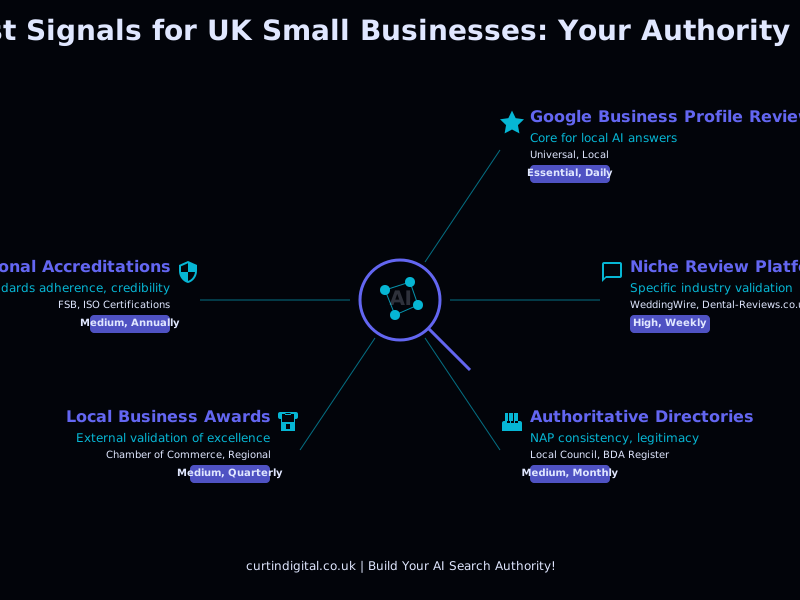
Key AI Trust Signals for UK Small Businesses
| Signal Type | UK Relevance/Examples | AI Trust Impact | Action Priority |
|---|---|---|---|
| Google Business Profile Reviews | Universal, Local | High: Core for local AI answers | Essential, Daily |
| Niche Review Platforms | WeddingWire, Dental-Reviews.co.uk | Medium-High: Specific industry validation | High, Weekly |
| Authoritative Directories | Local Council, BDA Register | Medium: NAP consistency, legitimacy | Medium, Monthly |
| Local Business Awards | Chamber of Commerce, Regional | High: External validation of excellence | Medium, Quarterly |
| Professional Accreditations | FSB, ISO Certifications | Medium: Standards adherence, credibility | Medium, Annually |
Why Authority Matters More Than Ever in AI Search
For AI search, solid third-party validation – things like positive customer reviews, credible industry listings, and recognised awards – acts as a critical trust signal that directly influences a business’s discoverability and ranking. Honestly, this is where the rubber meets the road for UK small businesses. Remember the E-E-A-T principle (Experience, Expertise, Authoritativeness, Trustworthiness) that Google has championed for years? Well, in the AI era, it’s not just important; it’s foundational. AI engines are constantly learning to “read” and verify information about your business from external sources, building a complete picture of your credibility. You can read more about Google’s approach to quality and trust in their Search Quality Rater Guidelines (pages 21-25 are particularly enlightening on E-E-A-T!).
Imagine AI as a meticulous detective. It doesn’t just take your word for it when you say your wedding venue is “award-winning.” Oh no, it goes out and checks. It looks for those awards on official industry sites, it reads what real couples say about their experience on WeddingWire, and it cross-references your business details across multiple reputable directories. The more consistent, positive, and authoritative these external signals are, the more confidence AI has in recommending your service. Makes sense, doesn’t it?
Let me give you a couple of examples I’ve seen play out. I worked with a lovely little independent interior design firm in Bristol. They had a fantastic website, beautiful portfolio, but their online presence beyond that was a bit thin. Meanwhile, a slightly less polished competitor down the road, who had actively encouraged Google reviews and proudly displayed a couple of local business awards, was consistently showing up higher in AI-generated answers for “best interior designers Bristol.” The difference? AI had more third-party evidence to validate the competitor’s claims. For the interior designer in Bristol, we focused on getting those genuine reviews and applying for local design awards. And honestly? The change in their visibility was remarkable!
Expert Tip: Think of AI as a very discerning customer. It wants proof! Just like you wouldn’t buy a car based solely on the seller’s claims, AI won’t recommend a business without solid, external validation. Every positive review or award is a little piece of evidence building your case.
The direct link between third-party validation and AI’s confidence in recommending your service? Undeniable. Consumers in the UK, according to recent studies by organisations like YouGov, place immense trust in online reviews – often as much as a personal recommendation. AI mirrors this human behaviour, you see. If it sees a restaurant with a thousand glowing reviews compared to one with ten, or a dentist with several prestigious industry awards versus one with none, it’s going to favour the business with the stronger, externally verified reputation. It’s simple logic, really. The more evidence AI has that your business is genuinely good, the more likely it is to put you front and centre. This is precisely the kind of thing my AI Search Optimisation services are designed to help UK businesses with – building that undeniable digital reputation.
Your Authority Toolkit: Reviews, Listings & Awards for UK SMBs
Right, this is where we get practical. Because for UK small businesses, building authority for AI search isn’t about being on every single platform out there. It’s about being strategically present where it matters most, and making sure those signals are loud and clear. Forget the idea that “G2 is only for software.” While G2 and Capterra are primarily for software, the principle behind them – peer reviews and credible listings – applies universally. See where I’m going with this?
Online Reviews: Your Digital Word-of-Mouth
For UK SMBs, your Google Business Profile (GBP) is your absolute bedrock. It’s where most local searches start and where AI will first look for social proof. Quantity, quality, and recency of reviews here are paramount. A gastropub with 500 recent, positive Google reviews will always outrank one with 50 outdated ones in AI search. Simple as that.
Beyond GBP, consider industry-specific review sites:
- Gastropubs/Restaurants: TripAdvisor, OpenTable, Squaremeal.
- Wedding Venues: WeddingWire, Hitched, Guides for Brides.
- Dental Practices: Dental-Reviews.co.uk, NHS Choices (for NHS practices).
- Estate Agents: AllAgents, Trustpilot (many estate agents use it successfully).
- Interior Designers: Houzz, Rated People.
The myth that Trustpilot is only for big corporations or software is just that – a myth. Honestly, it’s rubbish! Many UK service businesses, from florists to financial advisors, use Trustpilot successfully to build cross-platform authority. AI sees these multiple, consistent signals and gains confidence. I’ve seen businesses in the same town, offering similar services, with one struggling simply because they weren’t actively managing their online reviews. My advice? Don’t let that be you! For more on optimizing your most important listing, check out this guide on Google Business Profile optimisation to maximize your visibility. If you want to know more about my background and how I help businesses like yours, check out my About Don Curtin page.
Expert Tip: Don’t just collect reviews; engage with them! Responding to both positive and negative feedback shows AI (and potential customers) that you’re an active, caring business. This engagement is a huge trust signal, proving you’re genuinely invested in your customer experience.
Authoritative Listings & Directories: Beyond the Phone Book
This isn’t about signing up for every obscure online directory you find. Not at all. It’s about strategic, high-quality listings.
- Local Council Listings: Many local councils have business directories; these are incredibly powerful for local AI search.
- Professional Body Registers: If you’re a dentist, being listed on the British Dental Association (BDA) register is a huge trust signal. For estate agents, the National Association of Estate Agents (NAEA) or RICS.
- Niche UK Directories: Think about directories specific to your trade or region. For wedding venues, that might be a regional wedding guide. For gastropubs, a “best pubs in [county]” list.
- Companies House: Your official registration here is a fundamental signal of legitimacy that AI can and will check. Ensuring your business details are accurate and up-to-date with Companies House is a foundational step for any UK business.
While G2 and Capterra aren’t for most service businesses, the principle of being listed on a respected, curated platform is. AI looks for consistent NAP (Name, Address, Phone) information across these high-authority sites to verify your business’s existence and legitimacy. I once worked with a small, family-run bakery that had been serving their town for decades. They assumed their local reputation was enough. But when AI search started to take hold, they saw a dip. We focused on getting them listed accurately on local council sites, local food guides, and ensuring their Google Business Profile was impeccable. And honestly? It made a world of difference to their local search visibility. For more on this, you might find my article on local SEO strategies particularly useful.
Industry Awards & Accreditations: Badges of Honour
Nothing says “trustworthy” quite like a recognised award or accreditation. These are powerful badges of honour that AI (and your customers!) will notice.
- Local Business Awards: Often organised by chambers of commerce or local newspapers, these are fantastic for demonstrating community respect.
- National Industry Awards: Think AA Rosettes for gastropubs, British Dental Awards for dentists, UK Wedding Awards for venues, or various design awards for interior designers.
- Accreditations: ISO certifications, trade body memberships (e.g., Federation of Small Businesses - FSB, British Independent Retailers Association - BIRA), or specific quality marks. These not only signal quality to AI but also assure customers of your adherence to industry standards. For example, the Federation of Small Businesses offers great support and recognition for UK SMBs.
These aren’t just for bragging rights. Oh no. They are tangible proof of your excellence, verified by third parties. AI can crawl these award sites and professional bodies, seeing your business listed as a winner or an accredited member, and that significantly boosts its confidence in recommending you. Don’t underestimate the power of a genuine badge of honour.
Action Plan: How to Build & Use Your Authority Signals
Right, enough theory! Let’s get down to brass tacks. Building AI search authority for your UK small business isn’t a dark art; it’s a series of practical, budget-friendly steps you can take. I’ve helped countless businesses put these in place, and honestly, the biggest hurdle is often just knowing where to start.
Step 1: Audit Your Current Footprint
First things first, you need to know where you stand.
- Google Business Profile: How complete is it? What’s your current star rating? How many reviews do you have, and how recent are they?
- Other Review Sites: Check TripAdvisor, industry-specific sites, and Trustpilot if applicable. Are you listed? What are your scores?
- Directories: Do a quick search for your business name plus “directory UK” or “local listings Canterbury”. See where you pop up.
- Awards: Have you won any awards in the past? Are they still visible online?
This audit is your baseline. It helps you identify the biggest gaps and the quickest wins. Don’t worry if it’s not perfect; very few are when they start! It’s like checking the ingredients in your cupboard before you start cooking – you need to know what you’ve got to work with. Makes sense, right?
Step 2: Identify Key Platforms for Your UK Niche
Based on your audit, research 3-5 most relevant industry-specific review sites and directories for your particular UK service business.
- For a wedding venue: WeddingWire, Hitched, your local county’s wedding guides.
- For a dental practice: Dental-Reviews.co.uk, NHS Choices, and perhaps a local health directory.
- For a gastropub: TripAdvisor, OpenTable, and any prominent local food blogs or guides.
Focus your energy where your ideal customers are looking and where AI will expect to find you. Don’t spread yourself too thin – that’s a common mistake. It’s far better to have a strong, active presence on a few key platforms than a weak, neglected one on many. Spot on, really.
Step 3: Proactive Review Generation – Ask and You Shall Receive!
This is probably the single most effective step. Genuine customer reviews are gold for AI trust.
- In-person requests: A simple “If you enjoyed your experience, we’d love it if you could leave us a Google review!” can work wonders. Provide a QR code linked directly to your GBP review page.
- Follow-up emails: After a service, send a polite email asking for feedback and including a direct link to your preferred review platform.
- Website integration: Have a prominent “Leave a Review” button on your site.
- Respond to ALL reviews: This is non-negotiable. Thank customers for positive reviews. For negative ones, respond professionally, empathetically, and offer to take the conversation offline. I once saw a gastropub in Reading turn a one-star review into a five-star one by responding quickly and genuinely, inviting the customer back, and fixing the issue. AI sees that engagement and problem-solving, and it signals a trustworthy business. It’s proper customer service, that.
Don’s Top Tip: Never get into an argument in a public review response. Always offer to resolve privately. A calm, professional response to a negative review can actually increase trust, as it shows you’re committed to customer satisfaction. It’s a chance to show your true colours!
Step 4: Pursuing Awards & Accreditations
Don’t assume awards are out of reach! You’d be surprised.
- Research: Look for local business awards (Chamber of Commerce, local newspaper), regional industry awards, and national accolades relevant to your sector.
- Apply: Many awards have straightforward application processes. Highlight your customer service, community involvement, and business growth.
- Use Existing Accreditations: If you’re a member of a professional body (e.g., BDA, NAEA), ensure that’s prominently displayed on your website and listed correctly in directories. These are tangible proofs of your professionalism.
Step 5: Optimising Your Listings
Consistency is key. Ensure your NAP (Name, Address, Phone) is identical across every platform.
- Claim and verify: Claim your Google Business Profile, and any other relevant review sites or directories. This is like putting your name on your school work – it confirms it’s yours!
- Rich Profiles: Fill out every section – photos, opening hours, services, descriptions. The more complete, the better AI understands your business. Think of it as giving AI all the puzzle pieces to build a full picture of your fantastic business.
- Categories: Use accurate and specific categories on GBP and other directories. This helps AI understand exactly what you do. Get it sorted!
Expert Tip: Don’t forget about adding compelling images and videos to your listings! AI can “see” and understand visual content, and high-quality visuals of your premises, products, or services can significantly enhance your profile’s appeal and inform AI about your business’s offerings.
Step 6: Showcasing Your Authority
Once you’ve earned those reviews and awards, shout about them!
- Website: Create a “Testimonials” or “Awards” page. Integrate review widgets. Display award badges prominently (e.g., in the footer or on your “About Us” page).
- Marketing Materials: Include award logos on your brochures, business cards, and social media.
- Email Signatures: Add a link to “Read our reviews on Google!”
These steps, though seemingly simple, require consistent effort. But the ROI in terms of AI search visibility and customer trust is absolutely worth it. Remember, reviews and awards work hand-in-hand with other trust signals – combining them with a strategic brand mentions strategy creates a comprehensive trust profile that AI can’t ignore. If you’re feeling a bit overwhelmed by the prospect of putting all this in place, remember you don’t have to do it alone. Sometimes, the simplest way to get started is with a free, no-obligation chat to map out your unique AI search strategy.
Common Myths & Mistakes: Don’t Get Caught Out by AI Search Jargon
It’s easy to get tangled up in the ever-evolving world of AI search, and believe me, I’ve seen businesses make some avoidable errors. Here are a few common myths and mistakes I want to clear up, so you don’t get caught out. Let’s have a proper look, shall we?
Myth: “AI search means SEO is dead.” Reality: Absolutely not! SEO isn’t dead; it’s evolving. Instead of just optimising for keywords, you’re now optimising for trust, authority, and thorough answers. It’s a shift in focus, requiring a broader strategy that goes beyond just your website. The foundational principles of good SEO – quality content, technical hygiene, and user experience – are still incredibly important, but now we’re adding layers of external validation. Think of it as SEO getting a rather clever upgrade, not being replaced!
Mistake: Ignoring negative reviews. Reality: This is a huge one, and honestly, a missed opportunity. AI, like humans, understands that no business is perfect. It’s not the negative review itself that’s the problem; it’s the lack of a professional, empathetic response. Responding thoughtfully shows you care about your customers and are committed to resolving issues. I once knew a restaurant owner who, despite a few scathing reviews, managed to turn public perception around simply by engaging with every single piece of feedback, positive or negative, and always striving to make things right. That builds immense trust, both with customers and with AI. It’s like a good teacher addressing a problem in class – it shows leadership and care. Proper leadership, that.
Myth: “Only big businesses can get awards/listings.” Reality: Far from it! There are countless local business awards, regional distinctions, and niche industry accolades specifically designed for small and medium-sized enterprises in the UK. Many trade bodies offer accreditations that are perfectly accessible. It’s about finding the right ones for your business and making a compelling case. I’ve helped tiny local shops win awards that have completely transformed their local visibility, so don’t count yourselves out! Give it a go!
Mistake: Buying fake reviews. Reality: Please, please, please don’t do this. AI is getting incredibly sophisticated at detecting unnatural patterns, duplicate content, and suspicious activity. If caught, you risk severe penalties, including removal from Google Business Profile, which can be catastrophic for your local visibility. Authenticity is paramount for building genuine AI search authority. It’s simply not worth the risk. It’s like trying to cheat on a test; eventually, you’ll be found out, and the consequences are far worse than just getting a bad grade. Trust me on this one.
Myth: “G2/Trustpilot are only for software.” Reality: As I mentioned earlier, while G2 is indeed for software, Trustpilot is widely used by service businesses across the UK. But here’s the thing: even if these specific platforms aren’t right for you, the principle of them is vital. AI is looking for similar trust signals on platforms relevant to your niche. So, if it’s WeddingWire for a venue or Dental-Reviews.co.uk for a dentist, focus your energy there. Don’t let the jargon or specific platform names distract you from the core idea of building verifiable, third-party trust. That’s the real lesson here, and it’s something I often discuss when people ask me about Don Curtin and my approach to AI search optimisation.
Sources & Further Reading
- Google Search Quality Rater Guidelines: Provides insight into Google’s E-E-A-T principles.
- Search Engine Journal: A leading publication for SEO news and analysis, covering AI search impact.
- YouGov: UK-based research firm often cited for consumer trust and behaviour studies.
- Companies House: The official register of UK companies, a foundational source for business legitimacy.
- Federation of Small Businesses (FSB): Offers support, resources, and recognition for UK SMBs.
Related Reading
Brand Mentions vs Backlinks: Your UK SMB’s AI Search Superpower Reviews and awards are trust signals, but brand mentions amplify them further. Learn how to build a comprehensive trust profile that combines reviews, awards, and strategic brand mentions.
Future-Proof Your UK Google Business Profile for AI Search 2025 Your GBP is where reviews and awards are most visible to AI. This guide shows you how to optimize your profile to showcase these trust signals effectively.
Note: This article provides general guidance based on current best practices. Every business is different, and results may vary. For advice specific to your situation, get in touch.
Frequently Asked Questions
Is AI search going to replace Google as I know it?
Well, that’s a cracking question! From what I’m seeing, AI search, particularly through features like Google AI Overviews, is absolutely evolving how information is presented and discovered. It’s more of an enhancement to search, rather than a full replacement. Think of it like adding a new, super-smart assistant to your research team. Your core visibility strategy needs to adapt to this new landscape, focusing on trust and authority, but traditional search results still play a huge role. It’s about adapting, not abandoning! Understand?
My business isn’t on Trustpilot or G2. Am I doomed for AI search?
Oh, absolutely not! Please don’t worry about that. While those are prominent platforms, AI looks for authority relevant to your niche. For a UK small business, your Google Business Profile is foundational – that’s your starting point. After that, focus on industry-specific review sites and local directories that your customers actually use. That’s where AI will find the most relevant trust signals for your particular business. It’s all about being seen in the right places for your audience. Spot on!
How much time does it really take to manage reviews and listings?
That’s a very practical question, and I get it a lot! Initially, it does require a dedicated effort to set up and audit your existing footprint. Think of it as getting your house in order. Once established, dedicating just 1-2 hours a week to monitoring and responding to reviews, and checking for new listing opportunities, is usually sufficient. It’s an ongoing process, but consistency is key. It’s like tending a garden; a little bit of regular care keeps it thriving!
Can I just pay for an award to boost my AI search ranking?
Now, that’s a tempting thought, isn’t it? While some awards do have entry fees, genuine AI search authority comes from credible, recognised awards that reflect true merit. AI is pretty clever, you see. It can detect patterns that indicate a lack of true excellence, so focus on awards that genuinely celebrate your business’s quality and contribution, rather than just buying a badge. Authenticity always wins in the long run.
This all sounds a bit overwhelming. Where should a UK small business start?
I completely understand that feeling! It’s like looking at a huge syllabus and not knowing which chapter to tackle first. The absolute best place to start is always your Google Business Profile. Ensure it’s fully optimised, accurate, and actively encourage genuine customer reviews there. That’s your home base. Then, identify just one or two industry-specific platforms that are most relevant to your business and build your presence there. If you feel stuck or just want a second pair of eyes on your strategy, don’t hesitate to contact me for a chat – a quick, free audit can often clarify your next steps and get you moving in the right direction.
When reviews vanish or the listing wobbles
Trust signals need a live profile. See Why did my Google reviews stop showing? and Why doesn’t my business show up on Google?.
Taking the Next Step Towards AI Search Confidence
So, there you have it – a clear, no-nonsense roadmap to building AI search authority for your UK small business. We’ve demystified what AI search is actually looking for, why trust and reputation matter more than ever, and the practical steps you can take to make your business shine. Remember, AI rewards genuine reputation. And those authentic reviews, credible listings, and hard-earned awards are your most powerful allies in this new landscape.
This isn’t about being a tech wizard; it’s about smart, consistent effort in areas you likely already excel: fantastic customer service and building a strong local reputation. The future of search is here, and your business can absolutely thrive within it. You now have the knowledge to start building that vital AI trust. But, sometimes, knowing where to start, or ensuring you’re doing it right, can still feel like a bit of a faff, can’t it?
While this guide provides a solid foundation, navigating the nuances of AI search for your specific UK business can still feel like a puzzle. The businesses truly thriving are the ones who combine this foundational knowledge with tailored, expert guidance to ensure every step is optimised. Don’t let the technical jargon hold you back. I offer a free 10-minute AI Search Audit that provides clear, actionable insights specific to your UK business. It’s a no-obligation chat – just useful insights you can act on straight away. Why not book your free AI Search Audit today and see how we can get your business confidently leading the way in AI search?