Unlock Local: ChatGPT & Perplexity 'Near Me' for UK Businesses
📅 December 26, 2025 | ✍️ Don Curtin

Ever felt like the digital world is playing a tricky game of ‘pin the tail on the donkey’ with your local business, especially with all the exciting AI chatter? You’re definitely not on your own! I know it can feel a bit like trying to navigate a new roundabout in the fog, but I’m here to shine a light on how AI search, particularly ’near me’ queries, can genuinely boost your UK business.
- AI search is changing how UK customers find local businesses, making ’near me’ queries super important.
- ChatGPT is ace for creative content ideas, but it doesn’t do real-time local searches, bless its heart.
- Perplexity, with its live web access, is much better for finding accurate, up-to-the-minute local info.
- Crafting clever, location-specific prompts is your secret weapon for getting the best AI insights.
- Remember, AI is a brilliant assistant, but your traditional local SEO (like Google Business Profile) is still your bedrock!
Quick Stats
- Over 80% of consumers use search engines to find local information about businesses.
- Businesses leveraging AI for content generation can save an average of 30% in time and resources.
- ‘Near me’ searches have seen over 200% growth year-on-year, highlighting strong local intent.
Key Insights
- Your biggest opportunity is to understand that ’near me’ searches are no longer just about maps; AI is changing the game. Don’t get left behind!
- Focus on the right tool for the job: Think of ChatGPT as your creative brainstorming partner and Perplexity as your super-fast, fact-checking research assistant. Trying to make one do the other’s job will just lead to frustration.
- Prompt like a pro: The quality of your AI results hinges entirely on how well you ask the question. Learn to be specific with locations and intentions, and you’ll unlock incredible local insights.
- AI augments, it doesn’t replace: Your brilliant local business knowledge, customer understanding, and traditional SEO efforts are more vital than ever. AI just gives you a powerful new set of tools to amplify them.
The ‘Near Me’ Revolution: Why Local AI Search Matters for UK Businesses
Ever felt like you’re playing a game of hide-and-seek with your local customers online, especially with all this new AI buzz? You’re certainly not alone. If you’re running a fantastic business here in the UK – perhaps a charming gastropub in rural Oxfordshire, a bustling dental practice in London, or a beautiful wedding venue in Kent – you’ve probably heard about AI search. But let’s be honest, trying to figure out how it specifically helps your local bookings or footfall can feel like wading through treacle, can’t it? The jargon, the endless articles that don’t quite get our UK market, and that nagging fear of being left behind by competitors who seem to grasp this tech wizardry.
Well, let’s take a deep breath together. I get it. I’ve spent years simplifying complex ideas, and I’ve seen firsthand the frustration many UK business owners face when new tech emerges. My promise to you is this: by the end of this guide, you’ll clearly understand how ’near me’ queries work in two of the biggest AI tools, ChatGPT and Perplexity. More importantly, you’ll walk away with practical, UK-specific strategies – complete with prompt examples you can use today – to boost your local visibility. As a friendly, 40-year-old British teacher who’s helped countless UK businesses navigate the digital landscape, I’m here to simplify complex AI concepts into actionable steps you can use today. No confusing tech-speak, just straight talk about getting more local customers through your doors. If you want to dive deeper into the fundamentals first, my complete AI search guide provides the essential foundation you need.
Local AI search is completely changing how UK customers find businesses, making ’near me’ queries more powerful than ever. Seriously, they’re brilliant for driving local footfall and inquiries. Think about it: how often do you or your friends pull out a phone and ask, “best coffee shop near me” or “plumber in Wandsworth”? This isn’t just a trend; it’s how people live and shop today. The commercial intent behind these “near me” searches is huge – people aren’t just browsing; they’re looking to buy, visit, or book right now.
The truth is, AI’s completely changing this discovery process. Traditionally, we relied heavily on Google Maps and standard search results. Now, with generative AI tools entering the fray, customers are starting to ask questions in new ways, expecting conversational, precise answers. This shift presents both a challenge and a massive opportunity for UK businesses. I’ve spoken to so many owners, just like Sarah, who runs a gastropub in rural Oxfordshire. She’s seen her walk-ins dip and wonders if it’s because her competitors are somehow using this new tech. The confusion is palpable – what do these AI tools even do? How do they know where my business is? And do I really need another thing to learn? Understanding the mechanics of getting found locally through AI is the first step to staying competitive.
Expert Tip: I’ve noticed a real surge in what we call ‘micro-moments’ for local businesses. That’s when someone has an immediate need – “pizza near me,” “mechanic open now.” These aren’t just searches anymore; they’re conversations with AI, and your business needs to be part of that chat.
It’s completely understandable to feel overwhelmed. We’re a nation of SMBs, aren’t we? And for many of us, adapting to new tech can feel like a huge time investment we simply don’t have. A bit of a faff, really. But here’s the rub: with statistics from organisations like Ofcom consistently showing high rates of UK internet usage and digital adoption, having a strong digital presence, especially a local one, is no longer optional. It’s the absolute bedrock of competitiveness. If your potential customers are using AI to find local services, and you’re not optimising for it – well, you’re essentially leaving money on the table, aren’t you? Understanding these AI tools isn’t about becoming a tech guru overnight; it’s about staying relevant and ensuring your fantastic business is found when local customers are actively looking. That’s exactly where AI Search Optimisation services can make a real difference, helping you bridge that gap without adding another full-time job to your plate.
ChatGPT & ‘Near Me’: Decoding How It Works for Your Business
ChatGPT, while powerful for text generation, doesn’t have real-time location access, meaning its ’near me’ results are based on its vast training data and contextual understanding, not live geographic data. This is a really important distinction, and honestly, it’s one of the biggest misconceptions I encounter when talking to business owners. Many assume that because ChatGPT is so clever, it must know exactly where they are or where their customers are looking from. But here’s the simple truth: ChatGPT is a language model. Think of it like a super-intelligent, incredibly well-read librarian who has devoured an enormous library of books, articles, and websites right up until its last training cut-off date. It can recall and pull together information from that vast knowledge base, but it can’t look out of the window or check Google Maps in real-time.
How This Actually Works: The ‘Librarian’ Analogy
Imagine you’re in a grand old library, and ChatGPT is the incredibly knowledgeable librarian. You ask, “Where’s the best fish and chips near me?” The librarian, bless their cotton socks, doesn’t know your current location in the real world. What they do know is everything they’ve ever read about fish and chip shops, from reviews to historical articles, up to the point they last updated their knowledge (their ’training cut-off’). So, they might tell you what makes a good fish and chip shop, or perhaps mention some famous ones they’ve read about, or even suggest criteria for choosing one. But they can’t tell you the opening hours of the chippy just around the corner from where you’re standing right now, can they? It’s all based on their vast, but static, memory. This is why OpenAI’s documentation is quite clear about its capabilities and limitations regarding real-time data.
When you ask ChatGPT a “near me” query, it’s like asking that librarian, “What are the best Italian restaurants near me?” The librarian doesn’t know your current location. Instead, they’ll refer to their huge amount of knowledge about Italian restaurants in general, maybe mention some famous ones, or suggest criteria for finding a good one. They might even simulate a local search if you give them enough context, like “best Italian restaurants in Soho, London.” But it’s all based on the data it was trained on, not live, up-to-the-minute geographical information. Not at all. OpenAI, the creators of ChatGPT, are quite clear about its capabilities; it’s designed to understand and generate human-like text, not to be a real-time search engine.
So, what does this mean for your UK business? It means ChatGPT’s strength for local search lies not in finding live, specific businesses, but in idea generation and content outlining. For example, if you ask, “What are the best dental practices near me?”, ChatGPT might give you a generic list of characteristics of a good dental practice or perhaps some well-known chains, but it won’t pull up Dr. Smith’s Dental Surgery just down the road from you with their current opening hours and latest reviews. Its answers are often broad, based on patterns it learned from its training data. I’ve seen it give some cracking ideas for blog posts, but you’d always need to fact-check and localise them yourself. That’s a must.
Expert Tip: When I’m working with UK businesses, I often tell them to think of ChatGPT as their creative writing assistant. It’s brilliant for getting the initial ideas down or drafting content, but you’ll always need to sprinkle in your own local flavour and facts to make it truly shine and be accurate.
For a wedding venue owner, ChatGPT could be absolutely brilliant for brainstorming blog post ideas like “5 Magical Wedding Photo Locations in Kent” or drafting social media captions to attract local couples. For an interior designer, it could help outline a guide on “Trends in Coastal Kitchen Renovations in Brighton.” It’s spot on for getting the creative juices flowing and structuring your local content, but you’ll always need to inject your own local specifics and verify any factual claims, mind you. It’s a fantastic assistant for understanding what AI Search is conceptually and for content creation, but not for real-time local discovery.
Perplexity & Local Search: A Smarter Approach to ‘Near Me’ Queries
Perplexity’s real-time web access and citation features make it a much more powerful tool for accurate, source-verified ’near me’ local search insights compared to ChatGPT. Right, this is where things get really interesting, especially for us UK business owners who need concrete, up-to-date information. If ChatGPT is the super-smart librarian, Perplexity is like that librarian with a smartphone, who can instantly search the entire internet, pull up relevant articles, and even show you where they found the information. It’s a hybrid tool, blending the conversational power of a language model with the real-time data retrieval of a search engine. Pretty clever, eh?
How This Actually Works: The ‘Librarian with a Smartphone’ Analogy
Let’s go back to our library. You ask Perplexity, “What’s the best pub for a Sunday roast near the British Museum in London?” This time, our librarian (Perplexity) doesn’t just rely on memory. They whip out their smartphone, instantly search Google Maps, TripAdvisor, local London food blogs. Then, they quickly summarise the top recommendations, even showing you the links to those websites. Sorted! They’re not just recalling old data; they’re actively searching the live web to give you the most current, relevant answer, complete with sources you can check yourself. This real-time capability is a core feature of tools like Perplexity AI.
The key differentiator for Perplexity is its ability to access the web in real-time and, crucially, to cite its sources. When you ask Perplexity a “near me” query, it doesn’t just rely on its pre-trained knowledge. Instead, it actively performs a web search, much like Google or Bing, but then it processes those results, pulls together the information, and presents it in a conversational answer, complete with links to the websites it used. This means it can access live data from Google Maps, local business directories, review sites, news articles, and even social media feeds. This is a proper game-changer for local businesses!
Let’s say you’re Sarah, the gastropub owner in Oxfordshire. If you ask Perplexity, “What are the top-rated gastropubs near Chipping Norton, Oxfordshire, that offer a Sunday roast and have recent positive reviews?”, Perplexity will go out, search the web, likely pull up results from Google Maps, TripAdvisor, local food blogs, and then summarise its findings. Really useful stuff. It will then provide you with clickable links to those sources, allowing you to verify the information yourself. This is far more accurate and up-to-date than anything ChatGPT could offer for a specific local query.
I find Perplexity incredibly useful for actual local market research and competitive analysis. You can pinpoint local competitors, understand what customers are saying about them, identify local trends, and even find highly-rated local suppliers. For an estate agent in Manchester, Perplexity could help research local property market trends, find recent sales data, or identify the most common buyer questions in specific boroughs. For any AI for small businesses, having access to this kind of real-time, sourced information is absolutely invaluable for making informed strategic decisions, if you ask me. It’s like having a market research assistant who works at lightning speed and always shows their workings!
ChatGPT vs. Perplexity: Which AI Wins for Your UK Local Business?
For quick, creative local content ideas, ChatGPT shines, while Perplexity offers much better real-time, source-verified local search information for UK businesses. Right, we’ve got two clever AI tools, but they’re built for different purposes. Makes sense, doesn’t it? Think of it like this: if you need a beautifully written, imaginative story, you go to a novelist. If you need precise, up-to-the-minute news, you go to a journalist. ChatGPT is your novelist for content; Perplexity is your journalist for information.
Here’s a quick UK Business Owner’s Takeaway to help you decide which tool to reach for:
ChatGPT for UK Local Businesses:
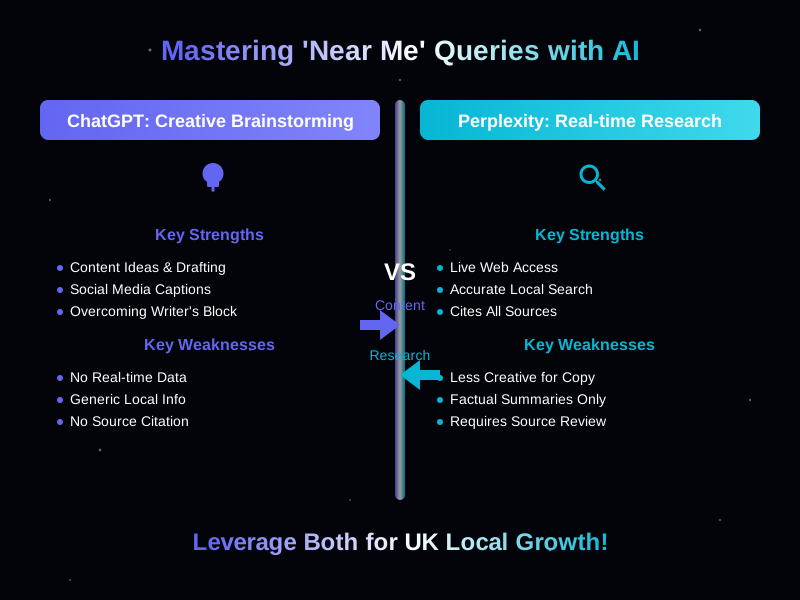
- Strengths: Brilliant for brainstorming, generating creative content (blog posts, social media captions, email drafts), drafting responses, and exploring broad ideas. It’s fantastic for getting a first draft or overcoming writer’s block for local marketing materials.
- Weaknesses: Lacks real-time data, so its “near me” results are often generic, outdated, or simply made up. Can’t verify facts or cite live sources.
- When to use it: When you need ideas or text. For example, a dental practice might use it to draft 5 blog post titles about “painless root canals in London” or create a social media calendar for local awareness campaigns. A wedding venue could ask for unique guest experience ideas for a Kent wedding.
Perplexity for UK Local Businesses:
- Strengths: Accesses the web in real-time, cites sources, provides more accurate and up-to-date local information. Brilliant for research, competitive analysis, and fact-finding.
- Weaknesses: Less creative for long-form content generation, focuses more on factual summaries.
- When to use it: When you need information or research. For instance, a gastropub owner could use it to find out what local competitors are offering for their Sunday roast, or an interior designer could research popular design trends in specific UK cities. An estate agent might use it to understand local property market sentiment.
A Simple Decision-Making Framework:
- If you need to create local content or brainstorm marketing angles: Use ChatGPT.
- If you need to research your local market, competitors, or get real-time local data: Use Perplexity.
Expert Tip: I always advise my clients not to pick a favourite, but to use both! They’re like two different, equally valuable tools in your digital toolbox. Using them together, playing to their strengths, is where the real magic happens for your UK business.
Ultimately, they’re complementary tools, really. Many successful UK business owners I work with use both. They might use ChatGPT to draft a compelling local offer and then switch to Perplexity to research the best local channels to promote it on. If you’re wondering how these strategies apply specifically to your gastropub in Oxfordshire, or your dental practice in London, sometimes a tailored chat can make all the difference. It’s why I offer a free AI Search Audit – no obligation, just a chance to explore your unique opportunities. Sound good?
ChatGPT vs. Perplexity: A Local Business Toolkit Comparison
| Feature | ChatGPT Strength | ChatGPT Weakness | Perplexity Strength | Perplexity Weakness |
|---|---|---|---|---|
| Real-time Data | None (static training data) | Cannot access live web for current info | Live web access, always up-to-date | May occasionally pull from less authoritative sources |
| Content Creation | Excellent for brainstorming & drafting | Lacks factual accuracy for local specifics | Less creative for long-form content | Focuses on factual summaries rather than narratives |
| Local Search Accuracy | Generic, often outdated or simulated | Cannot verify real-world locations or details | High accuracy for ’near me’ queries | Can sometimes be too concise in summaries |
| Source Citation | None | Cannot show where information came from | Explicitly cites all web sources | Citations can be numerous, requiring review |
| Best Use Case | Marketing content ideas, blog outlines | Real-time local business discovery | Local market research, competitive analysis | Generating imaginative marketing copy |
Actionable Strategies: Using AI for UK Local Visibility (Prompt Examples!)
Crafting specific, location-aware prompts is key to using AI tools like ChatGPT and Perplexity for boosting your UK local business visibility and getting actionable insights. It’s not just about asking a question. No, it’s about asking the right question, in the right way. With enough context, the AI will give you truly useful, UK-centric answers. This is what we call ‘prompt engineering’, and it’s a skill well worth developing, if you ask me. Let me show you how with some practical, real-world examples.
Here are some prompt templates you can literally copy, paste, and adapt for your own UK business:
Prompt 1: Local Market Research (Using Perplexity)
- Goal: Understand what makes local competitors stand out.
- Prompt: “Using Perplexity, find popular wedding venues near Kent and their unique selling points, including customer reviews. Summarise their top 3 strengths and weaknesses based on public feedback.”
- Why it works: It specifies the tool, the location, the business type, and asks for actionable insights (USPs, strengths/weaknesses from reviews). Perplexity will search local directories, review sites like TripAdvisor or Google Maps, and venue websites. This is brilliant for understanding the competitive landscape for UK wedding venues, especially those charming, often family-run establishments that rely on local reputation.
- What to look for: Direct quotes from reviews, recurring themes in feedback, specific features or services that competitors highlight.
Prompt 2: Competitor Analysis (Using Perplexity)
- Goal: Identify what customers love about top local competitors.
- Prompt: “Using Perplexity, identify the top three gastropubs in rural Oxfordshire that offer a Sunday roast and summarise what customers love most about them, citing specific examples from reviews.”
- Why it works: Very specific. It asks for a number of competitors, a specific offering, and focuses on customer sentiment with citation. This helps you benchmark and find gaps. For a UK gastropub, this could reveal insights into preferences for local produce, the quality of Yorkshire puddings, or the cosiness of the atmosphere – all crucial details for our discerning British diners!
- What to look for: Common positive keywords (e.g., “crispy roasties,” “friendly atmosphere,” “great value”), unique menu items, or special offers.
Prompt 3: Content Idea Generation (Using ChatGPT)
- Goal: Brainstorm engaging blog post topics for a local audience.
- Prompt: “Using ChatGPT, give me 5 blog post ideas for a dental practice in London focused on ‘painless root canals near me’ that address common patient fears and include a local London angle.”
- Why it works: Leverages ChatGPT’s creativity for content. It specifies the number of ideas, the service, the pain point (fears), and the local context. This helps a London dental practice create content that resonates with the specific concerns and search habits of city dwellers.
- What to look for: Catchy titles, ideas that resonate with local concerns (e.g., “Finding a Gentle Dentist in Hackney”), and clear angles for each post.
Prompt 4: Local SEO Optimisation (Using Perplexity)
- Goal: Discover long-tail keywords and local search terms.
- Prompt: “Using Perplexity, suggest long-tail keywords for a Brighton interior designer targeting clients looking for ‘coastal kitchen renovations’. What specific local search terms might people in Brighton or Hove use when looking for this service?”
- Why it works: Uses Perplexity’s real-time search to identify actual phrases people type. It focuses on long-tail (more specific) keywords and asks for local variations. This is brilliant for capturing the nuances of how people in specific UK coastal towns search for specialised services.
- What to look for: Phrases like “Brighton beach house kitchen designer,” “Hove bespoke kitchen remodelling,” “coastal style kitchen ideas Sussex.”
Prompt 5: Customer Service FAQ Development (Using ChatGPT)
- Goal: Draft responses for common local customer questions.
- Prompt: “Using ChatGPT, draft concise, friendly responses for common questions an estate agent in Manchester might get about ‘property valuations near me’ or ‘first-time buyer advice in Manchester’. Include a call to action for booking a free consultation.”
- Why it works: ChatGPT excels at drafting conversational text. It specifies the persona, the questions, the location, and a desired CTA. This helps UK estate agents quickly generate helpful, locally relevant content for their website or customer service.
- What to look for: Clear, helpful answers that address concerns, reinforce trust, and guide the customer to the next step.
Expert Tip: Don’t be afraid to iterate! If your first prompt doesn’t give you exactly what you need, tweak it. Add more detail, specify the tone, or ask for a different format. It’s a bit like teaching – sometimes you need to rephrase the question for the best answer.
These prompts are just the starting point, of course. The real magic happens when you experiment, refine, and adapt them to your unique business needs. I’ve often found that a little trial and error with prompts can give surprisingly powerful results, sometimes even uncovering market insights I hadn’t considered. If you’re keen to dive deeper and explore my range of services, we can craft a bespoke AI strategy that really puts these tools to work for your business. Proper job!
Common Pitfalls & The Future of Local AI Search
While powerful, AI tools require human oversight and strategic prompting to avoid common local search pitfalls and truly optimise for future trends like Google’s AI Overviews. It’s easy to get swept up in the excitement of AI, but like any powerful tool, it comes with a few traps. I’ve learned this the hard way myself – I once spent a good hour trying to get ChatGPT to give me real-time traffic updates for my commute, only to realise it simply couldn’t! It was a good reminder that even the smartest AI has its limitations. And that’s okay!
Common Pitfalls to Watch Out For:
- Over-reliance without human verification: AI can confidently give you wrong information. Always double-check critical details, especially for local business specifics like opening hours, addresses, or pricing. Imagine giving a customer incorrect directions to your charming B&B because AI got it wrong – not ideal, is it?
- Data accuracy issues (especially with older ChatGPT data): ChatGPT’s knowledge cutoff means it might not have the latest information about a newly opened gastropub or a recent change in local regulations. Perplexity is better here, but still requires a critical eye.
- Not double-checking sources: Even Perplexity, which cites sources, can pull from outdated or less reputable websites. Always click through and verify if the information is crucial. Think of it like checking the references in a student’s essay!
- Lack of human nuance in AI responses: AI can struggle with the subtle cultural context or emotional intelligence needed for truly effective local marketing or customer service. It might miss the unique charm of a specific High Street or the particular dialect of a county.
Myths vs. Reality: What UK Business Owners Need to Know
Let’s clear up a couple of common misunderstandings I hear when I chat with UK businesses:
- Myth: “AI will replace my local SEO expert.”
- Reality: AI is a tool for experts, not a replacement. It helps human capability, helping with research and content generation, but strategic oversight, local knowledge, and human creativity are truly irreplaceable. Your local SEO expert understands the unique quirks of the UK market, which AI simply can’t replicate.
- Myth: “AI inherently knows where my shop is located.”
- Reality: As we’ve discussed, only tools with real-time web access (like Perplexity) can infer location from web data. ChatGPT doesn’t have this. Your Google Business Profile and traditional local SEO are still absolutely crucial for telling the digital world exactly where you are.
Future Trends: What Don’s Expert Take Means for UK SMBs The landscape is evolving at lightning speed. Google’s Search Generative Experience (SGE), now often referred to as Google’s AI Overviews, is a huge one. This is Google bringing generative AI directly into its search results, potentially giving summarised answers at the top of the page, sometimes even for local queries. This means that getting your business found might increasingly depend on how well your online presence is understood by these AI systems.
For UK SMBs, this means:
- Even greater emphasis on foundational local SEO: Your Google Business Profile must be absolutely spot on. Consistent NAP (Name, Address, Phone) data across the web is crucial. Think of it as your digital passport – it needs to be perfectly in order!
- Quality, unique content: AI loves well-structured, authoritative content. Producing helpful, localised content will be more important than ever. If you’re a local bakery, sharing recipes, stories about your community, or behind-the-scenes glimpses will resonate with both customers and AI. To measure whether your efforts are working, my guide on free tracking tools shows you exactly what to monitor.
- Understanding prompt engineering: As customers ask AI more complex, conversational questions, your ability to optimise your content to answer those questions will be a significant advantage. This is where AI Search Optimisation really comes into its own.
It can feel like a lot, can’t it? But here’s my expert take: don’t panic, but do prepare. The businesses that thrive will be those that use these tools strategically, seeing them as powerful assistants rather than replacements. Staying informed and adaptable is key. If you’d like to chat more about Don Curtin and his approach to navigating these changes, you know where to find me.
Sources & Further Reading
- Ofcom: Consistently reports on UK internet usage and digital adoption trends.
- Google (AI Overviews): Provides updates on integrating generative AI into search results.
- Search Engine Journal: Offers expert insights and news on SEO and AI in search.
- OpenAI: The creators of ChatGPT, detailing its capabilities and limitations.
- Perplexity AI: The official source for information on Perplexity’s real-time web access.
Related Reading
Future-Proof Your UK Google Business Profile for AI Search 2025 Your GBP is the primary source for “near me” queries in AI search. This comprehensive guide shows you how to optimize every aspect of your profile to capture local ChatGPT and Perplexity searches.
Voice Search and AI: The UK Local Business Smart Speaker Playbook Voice-activated “near me” searches are exploding. Learn how to optimize for Alexa, Google Assistant, and other smart speakers to capture these high-intent local queries.
Note: This article provides general guidance based on current best practices. Every business is different, and results may vary. For advice specific to your situation, get in touch.
Frequently Asked Questions
Can ChatGPT directly find my business’s real-time opening hours or customer reviews?
No, I’m afraid ChatGPT can’t do that directly. It relies on its static training data, which means it doesn’t have live access to current information like opening hours, daily specials, or the very latest customer reviews. For real-time, specific business information, I’d always recommend using Perplexity or a direct search engine like Google – they’re far more reliable for that kind of query because they can actually browse the live web for you.
Is using AI for local search a replacement for traditional local SEO strategies (like Google Business Profile)?
Absolutely not, and this is a really important point! AI is a fantastic addition to your local SEO toolkit. It helps with strategy, content creation, and market research, giving you insights you might not have found as quickly otherwise. However, foundational local SEO practices – like optimising your Google Business Profile, ensuring consistent business information across online directories, and getting local reviews – remain absolutely crucial, believe me. Think of AI as your super-powered assistant, not your entire team! Your Google Business Profile is still the absolute bedrock of your local digital presence.
How accurate are the ’near me’ results from these AIs for specific UK locations?
Generally speaking, Perplexity is much more accurate for ’near me’ queries because it accesses the live web and cites its sources, pulling in information from places like Google Maps and local directories. So, if you’re asking about a specific pub in a particular village, Perplexity is your best bet. ChatGPT’s accuracy for specific UK locations depends entirely on how recent and detailed its training data is for that particular area, so its answers tend to be more generic or less reliable for up-to-the-minute local details. So, always, always verify critical information yourself!
What’s the very first step a UK business owner should take to start using AI for local search?
My advice would be to start by experimenting with Perplexity. Use it for local market research – try finding out what your local competitors are doing well, or what local customers are searching for in your area. You could even ask it to summarise local news relevant to your industry. Once you’re comfortable with that, then move on to using ChatGPT for generating content ideas tailored to your local audience. The key is to start small, understand how they work. Then, focus on understanding your local market better with these new tools.
I’m overwhelmed by all this AI talk. Can someone help me implement these strategies for my specific UK business?
You are absolutely not alone in feeling overwhelmed, and yes, I can certainly help! Navigating the rapidly evolving world of AI search can be complex, and trying to figure out how it applies specifically to your unique UK business can be a challenge. That’s exactly why I offer a free AI Search Audit. It’s designed to help UK businesses like yours understand your unique local AI search opportunities and get started effectively, without the jargon or the pressure. Let’s have a friendly chat about it!
“Near me” still leans on Google Maps
If the map pack ignores you, AI near-me answers usually will too. Why doesn’t my business show up on Google Maps? · full triage.
Taking the Next Step in Your Local AI Journey
Well, there you have it! We’ve demystified how ’near me’ queries function in ChatGPT and Perplexity, explored their unique strengths, and armed you with actionable, UK-specific prompt examples, too. You now understand that while ChatGPT is a creative genius for content ideas, Perplexity is your reliable journalist for real-time local insights. This knowledge isn’t just academic, mind you. It’s your competitive edge in a rapidly evolving digital landscape.
The businesses truly winning in this new AI landscape aren’t just reading articles; they’re taking decisive, informed action to understand and make the most of their unique local AI search opportunities. Are you ready to be one of them? I firmly believe that with the right guidance, any UK business owner can use the power of AI to attract more local customers. If you’re wondering how these strategies apply specifically to your gastropub in Oxfordshire, or your dental practice in London, sometimes a tailored chat can make all the difference. Don’t let the competition get ahead – understanding your local AI search landscape and getting tailored advice is the absolutely crucial first step.
If you’d like to cut through the noise and get a clear picture of how AI search can specifically benefit your business right here in the UK, why not reach out? I offer a free AI Search Audit where we can pinpoint exactly where your business can gain a local edge in this evolving AI landscape. No obligation, no sales pitch – just proper useful insights you can act on straight away. Let’s make sure your fantastic local business isn’t just found, but truly shines in the age of AI.