Voice Search & AI: The UK Local Business Smart Speaker Playbook
📅 December 26, 2025 | ✍️ Don Curtin

Right, fancy a quick chat about getting your brilliant UK business found by smart speakers? I know it sounds a bit techy, but trust me, it’s easier than you think, and absolutely vital for catching those local customers asking ’near me’ questions. Let’s make sure your business is the one they hear about!
- Your Google Business Profile is king for local voice search, so get it spotless!
- People chat to AI, so use conversational, ’near me’ keywords in your content.
- AI Overviews are changing things; clear, factual info is your golden ticket.
- Schema markup might sound scary, but it helps AI understand your business.
- Reviews are gold – they build trust and give AI juicy info about you.
Quick Stats
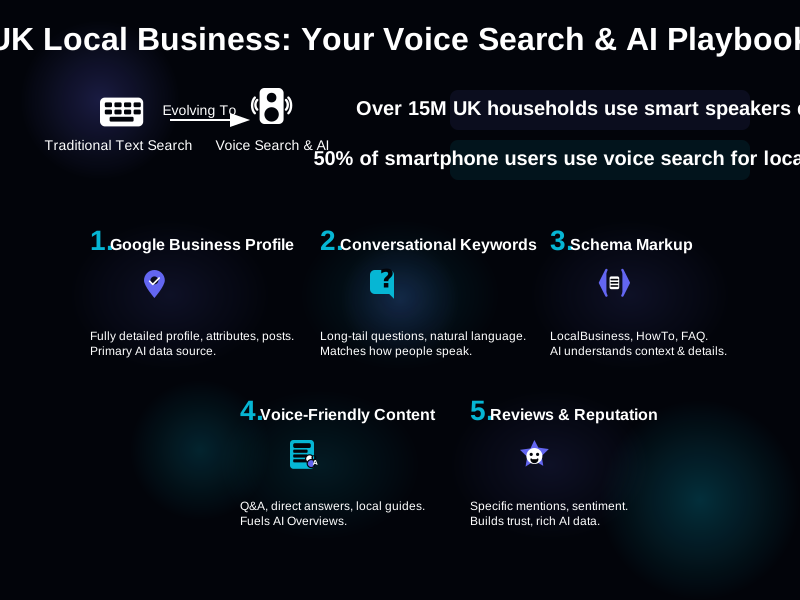
- Over 15 million UK households now use smart speakers daily, changing how local businesses are found.
- 50% of smartphone users have tried voice search for local queries, seeking immediate, nearby solutions.
- Businesses optimised for AI Overviews gain direct, concise answers for customers, boosting visibility.
Key Insights
- Your biggest challenge won’t be the technology itself, but shifting your mindset to how people actually talk when they’re looking for you. Forget dry keywords; think real conversations!
- Focus on making your online presence undeniably clear and consistent. If Google’s AI can’t verify your opening hours easily, you’re out of the running for a voice answer.
- Don’t underestimate the power of local reviews. I’ve seen them directly influence AI recommendations, acting as genuine social proof for your business.
- Remember, this isn’t just about ‘SEO’ anymore; it’s about being the most helpful, human-like answer for someone asking a question. Be that trusted friend!
What’s the Buzz? Voice Search, AI & Your UK Local Business
Right, UK local businesses – it’s time to really embrace voice search. AI-powered smart speakers are fast becoming the main way customers find local services. I’ve seen firsthand how quickly consumer habits are shifting, and honestly, ignoring this trend is a risk you simply can’t afford to take. It’s that important.
So, what exactly are we talking about, then? Voice search is simply using your voice to ask a question or give a command to a device – your phone, your car’s infotainment system, or a smart speaker. And those smart speakers, the likes of Amazon Echo (Alexa), Google Nest, and Apple HomePod, they’re absolutely everywhere now, aren’t they? In our kitchens, living rooms, even bedrooms. They’ve become our digital assistants, ready to answer questions, play music, or help us find a local business. Pretty handy, really. If you’re new to this whole AI search concept, my guide on AI search for UK businesses provides a solid foundation for understanding how it all works.
And what’s powering all this cleverness, you ask? Artificial Intelligence, or AI. AI is the brain behind these interactions. It understands your spoken words, interprets your intent, and then pulls information from the vast expanse of the internet to give you the most relevant answer. It’s not just about recognising words, you see; it’s about understanding what you mean when you say “find a good plumber near me” or “what’s on at the local cinema?” This shift from typing to talking is profoundly changing how people discover and engage with businesses. Think of it like a really clever assistant who doesn’t just hear your words, but understands your unspoken needs, the context, and even your local accent – which, let’s be honest, can be a bit of a challenge for some tech!
Now, let’s talk numbers, because they really paint a picture, don’t they? According to [Ofcom's latest Communications Market Report](https://www.ofcom.org.uk/research-and-data/multi-sector-research/cmr) (a fantastic source for UK digital trends, by the way!), smart speaker adoption in the UK has absolutely skyrocketed. We’re talking millions of households now using these devices daily. And [Statista backs this up](https://www.statista.com/statistics/1089859/voice-assistant-usage-uk/), showing a consistent upward trend in voice assistant usage. For a local business, this isn’t just some fleeting tech fad; it’s a fundamental change in how your potential customers are looking for you. Imagine a customer, let’s call him Mark, who’s just moved to Manchester. He’s relaxing at home, thinks “I fancy a proper Italian tonight,” and instead of pulling out his phone to type, he casually asks his Google Nest, “Hey Google, where’s the best Italian restaurant in Didsbury?” If your lovely Italian trattoria isn’t optimised for that kind of query, well, you’re simply not in the running for Mark’s custom, are you?
Expert Tip: I often tell my clients this: if you’ve ever asked your smart speaker for something local, you’ve already experienced the power of this shift. Now, let’s make sure it’s your business popping up in those answers! If you’re curious about my background and how I help businesses, you can always
[read more about me here](/about/).
Local businesses, from independent boutiques to your friendly local dentist, are uniquely positioned to benefit from this shift. Voice search is inherently local, you see. When people ask a smart speaker for something, it’s often because they need it now and nearby. They’re looking for opening hours, directions, availability, or recommendations for services right on their doorstep. If you’re running a high street business, this isn’t some abstract online marketing concept; it’s about getting found by people physically close to your premises, ready to become your next customer. Ignoring this means missing out on a growing slice of the local market, and frankly, I don’t want to see any good British business fall behind. Not on my watch! It’s time to get your business speaking the language of smart speakers. Let’s get it sorted!
The AI Overviews Effect: Why Local Voice Search Just Changed
Google’s AI Overviews are fundamentally changing local voice search. They’re providing direct, AI-generated answers, which makes it absolutely crucial for UK businesses to optimise for concise, factual information. Honestly, this is perhaps the most significant shift we’ve seen in search in a long, long time, and it has a profound impact on how your business gets discovered, especially through voice. A real game-changer.
So, what are these “AI Overviews” everyone’s talking about, then? In simple terms, Google’s bringing in a new feature right at the top of its search results page. Instead of just showing you a list of ten blue links, AI Overviews (AIOs) use generative AI to summarise information from various sources on the web and present a direct, concise answer to your query. Think of it as Google trying to be even more helpful, giving you the answer upfront without you necessarily needing to click through to a website. It’s almost like having a super-smart librarian who reads all the relevant books for you and gives you the perfect summary straight away. And for voice search, this is brilliant – you don’t want a long list, you want the answer. [Search Engine Journal has some excellent insights into how AI Overviews are impacting SEO](https://www.searchenginejournal.com/google-ai-overviews-impact-on-seo/) if you fancy a deeper dive.
Now, how does this influence local search results, particularly for voice queries? Well, it’s a proper game-changer. When you ask a smart speaker a question, you’re not expecting a list of ten websites, are you? No, you’re expecting a single, direct answer. And AI Overviews are designed to provide exactly that. For instance, if someone asks their smart speaker, “What’s the opening time for The Old Bell Inn gastropub in Hurley today?” an AI Overview could directly state, “The Old Bell Inn in Hurley is open from 12 PM to 10 PM today, according to its Google Business Profile.” Or, if they ask, “Tell me about a highly-rated wedding venue near Tunbridge Wells,” the AI might summarise key features and reviews from a top-ranked venue. See where I’m going with this?
This means a pretty significant shift from the traditional “10 blue links” model. While those links won’t disappear entirely, the prime real estate right at the very top of the search results – the first thing a smart speaker will likely read out – will be occupied by these AI-curated summaries. For local businesses, this creates both a challenge and a massive opportunity. The challenge? If your business isn’t featured in that AI Overview, you might lose immediate visibility. The opportunity? If you are featured, you gain unparalleled direct exposure and credibility. Which is brilliant, really.
So, how can your local business position itself to be featured in these coveted AI Overviews for voice queries? Well, it boils down to providing clear, concise, and verifiable information that Google’s AI can easily understand and trust. This means ensuring your key business details – your name, address, phone number, opening hours, services, and even frequently asked questions – are impeccably accurate and consistently presented across your Google Business Profile and your website. The AI needs to be able to quickly grab the facts it needs, doesn’t it? What’s more, having high-quality, authoritative content that directly answers common questions (which we’ll delve into more later) will make your site a prime candidate for the AI to draw its summaries from. It’s about being the most helpful, most factual source out there, so when someone asks, your business is the first one the AI thinks of. It’s not about tricking the system; it’s about making it undeniably easy for the AI to understand and recommend you. Simple as that.
Traditional SEO vs. Voice Search Optimisation
| Aspect | Traditional SEO Focus | Voice Search Focus | Benefit for Local UK Business |
|---|---|---|---|
| Keyword Strategy | Short, exact match | Conversational, long-tail questions | Matches how people actually speak, captures intent. |
| Google Listing | Basic NAP | Fully detailed GBP, attributes, posts | Primary data source for AI, boosts confidence. |
| Content Style | Keyword-rich text | Q&A, direct answers, local guides | Fuels AI Overviews, provides helpful answers. |
| Schema Markup | Basic site structure | LocalBusiness, HowTo, FAQ | AI understands context & specific details. |
| Reviews | Quantity, stars | Specific mentions, sentiment, responses | Builds trust, provides rich AI data for recommendations. |
| Mobile Optimisation | Responsive design | Speed, mobile-first, local intent | Captures on-the-go queries, improves user experience. |
Your UK Local Business Smart Speaker Playbook: Step-by-Step
Optimising for UK local voice search is a multi-step process, mind you. It starts with a fully optimised Google Business Profile and extends to conversational keyword research, local schema markup, and voice-friendly content creation. Think of this as your essential guide, a series of practical steps you can take without needing to hire a huge team or spend a fortune. Let’s get cracking, shall we? I’ve seen these steps work wonders for businesses just like yours across the UK. Absolutely spot on, they are.
Step 1: Master Your Google Business Profile (GBP) for Voice
Honestly, getting your Google Business Profile absolutely spot-on is the single most important thing you can do for local voice search. No question. It’s the primary source of information smart speakers pull from for local queries, so if your GBP isn’t perfect, you’re effectively invisible to many voice searchers. Think of it like having the best shop on the high street but forgetting to put up a sign! I’ve seen firsthand how crucial this is for UK businesses. A real no-brainer, this one.
- Complete & Accurate Information: Make sure every single field is filled out. This includes your exact business name, address, phone number (NAP), website, opening hours (and special holiday hours!), services offered, and categories. If your gastropub closes early on Tuesdays, that needs to be clear. If your dental practice offers emergency appointments, ensure it’s listed. Don’t forget the ‘Attributes’ section either – do you offer wheelchair access? Free Wi-Fi? Outdoor seating? These details are golden for specific voice queries.
- Consistency is Key: Your NAP details must be identical everywhere online – your website, social media, other directories. Inconsistent information confuses AI and makes it less likely to trust your data. Imagine a smart speaker trying to find your business and getting two different addresses – it just won’t know which one to trust, so it might just recommend a competitor!
- Optimising Descriptions for Natural Language: Use the “From the business” description to include conversational phrases customers might use. Instead of just “Dental Practice,” you might add “Offering pain-free dental care and cosmetic dentistry in Edinburgh city centre.” For a wedding venue, think “Stunning barn wedding venue in rural Kent with catering options.”
- Photos & Virtual Tours: High-quality photos of your premises, products, or services make your profile more engaging and trustworthy. A virtual tour can be a real differentiator.
- Regular Updates: Keep your posts section active with offers, news, or events. This shows Google your business is alive and well.
Don’s Tip: I’ve seen businesses lose out on customers simply because their GBP had old opening hours. Set a reminder to check it quarterly, especially for seasonal businesses! For a deeper dive, I’ve put together some thoughts on [optimising Google Business Profile for local businesses](/blog/optimising-google-business-profile-guide/).
Step 2: Speak Their Language: Conversational Keywords & Long-Tail Queries
This is where we really start thinking like a smart speaker user, moving from formal search terms to everyday chit-chat. People don’t talk to Alexa or Google Assistant the same way they type into a search bar, do they? They use natural, conversational language. It’s like moving from a formal letter to a friendly chat over a cuppa! Much better, honestly.
- Beyond Single Keywords: Forget just “plumber London.” Think “Hey Google, who’s the best emergency plumber in Southwark who can come out tonight?” or “Alexa, find a child-friendly gastropub with a beer garden near me in Bristol.”
- Identifying Conversational, Local & Intent-Based Queries:
- Conversational: “How much does X cost?”, “Where can I find Y?”, “What are the best Z for…?”
- Local: Include place names (boroughs, towns, landmarks), “near me,” “in [postcode area].”
- Intent-Based: “Book a table,” “get a quote,” “find opening hours.”
- Tools for Keyword Research:
- Google Autocomplete: Start typing a question into Google and see what suggestions pop up. This is a goldmine for understanding what people actually search for.
- “People Also Ask” (PAA) boxes: These are brilliant for understanding related questions and common conversational queries.
- Google Search Console: Look at your existing queries to see how people are already finding you. You might be surprised by the natural language they’re using!
- When using tools like Google Autocomplete or ‘People Also Ask’ boxes, pay close attention to the questions people are asking, won’t you? These are direct insights into their voice search behaviour. For a more visual approach,
[AnswerThePublic.com](https://answerthepublic.com/)is a fantastic free tool that visualises questions people ask around a topic, giving you a real treasure trove of conversational keywords. And remember, your own customer service team or receptionists are often the best source of ‘real-world’ questions!
Expert Tip: Don’t just rely on tools! I always encourage business owners to literally role-play. Imagine you’re a customer in a hurry, what would you say to your smart speaker? Write those down – they’re your best keywords!
For a wedding venue, instead of “Kent wedding venue,” think “wedding venues with outdoor ceremony Kent,” “rustic wedding venues near Maidstone,” or “how much does a wedding venue cost in Kent?”
Step 3: Implement Local Business Schema Markup
Now, this might sound a bit technical, but bear with me – it’s crucial and actually quite straightforward to get the basics right for helping AI understand your business. Schema markup is like a secret code you add to your website that helps search engines (and by extension, AI) understand exactly what your content means. It’s not visible to your website visitors, but it’s invaluable for the machines. Think of it as giving Google’s AI a perfectly organised, colour-coded file rather than a messy pile of papers. Makes a big difference, honestly.
- Simple Explanation: Imagine you have a menu. You know “Starters” means appetisers. Schema tells Google, “This text here? This is the name of my business. This number? That’s the phone number.” It removes ambiguity.
- Essential
LocalBusinessSchema Properties:name: Your business name.address: Your full postal address.telephone: Your contact number.openingHours: Your daily opening and closing times.url: Your website URL.priceRange: (e.g., ££ for a gastropub).hasMap: Link to your Google Maps listing.aggregateRatingandreview: To highlight your customer reviews.servesCuisine(for restaurants),acceptsReservations,paymentAccepted,areaServed(e.g., “Edinburgh” for a dental practice).[You can find a comprehensive list of schema types at Schema.org](https://schema.org/).
- How it Helps: By clearly labelling this information, you make it incredibly easy for AI to pull out the precise details for voice search results and AIOs. And that boosts the confidence AI has in your data, making you a more likely candidate for direct answers. Spot on. Most modern website builders or SEO plugins (like Yoast for WordPress) have built-in schema functionality, so you often don’t need to be a coding wizard. Once you’ve added it, I always recommend using
[Google's Rich Results Test](https://search.google.com/test/rich-results)to check your work. It’s a brilliant, free tool that tells you if Google can correctly read your schema – no point putting in the effort if the AI can’t understand it, right?
Step 4: Create Voice-Friendly Content: Q&A and Local Guides
Once your GBP is sorted and you know how people are talking, it’s time to create content that directly answers those conversational queries, allowing you to truly shine as a helpful local resource. This is where you can really make your mark as a helpful resource, you know? Imagine you’re having a delightful chat with a customer, answering all their burning questions – that’s the vibe we’re going for! Proper helpful stuff.
- Developing Q&A Content: Think of all the questions your customers ask you. “Do you have vegetarian options?”, “How long does a dental check-up take?”, “What’s included in your wedding package?”, “Do you allow dogs?”. Turn these into an FAQ section on your website, or even dedicated blog posts. Each question should be a clear heading, followed by a concise, direct answer. This is perfect for AI Overviews and voice assistants!
- Creating Local Guides & Blog Posts:
- “The Best Sunday Roasts in South London” (if you’re a gastropub).
- “Top 5 Things to Consider When Choosing a Wedding Venue in Kent.”
- “Emergency Dentist in Edinburgh: What to Do in a Dental Crisis.”
- Include “near me” phrases naturally within your content. Talk about local landmarks, areas, and specific postcodes. For example, a wedding venue could have a blog post titled “Our Top Tips for Planning a Wedding Near Canterbury Cathedral.” Understanding how to structure this content effectively is crucial – my guide on local query optimisation dives deeper into what makes AI recommend specific businesses.
- Be the Expert: Don’t just list services; provide helpful, genuinely useful information. This builds trust, you see, and really positions you as an authority – which AI absolutely loves. My detailed playbook on content structure for AI shows you exactly how to format your content so AI can easily quote and reference it.
Step 5: Harness Reviews & Reputation Management
Positive reviews are like gold dust for local businesses, and their power is truly amplified in the age of voice search and AI. They build trust, influence rankings, and often contain the very keywords people use in voice queries. Think of each great review as a little cheer for your business that Google’s AI absolutely loves to hear! Proper brilliant, that.
- The Power of Positive Reviews: When someone asks their smart speaker, “Find a highly-rated gastropub near me,” those star ratings and review snippets are crucial. AI systems use review sentiment as a strong signal of quality and reliability, you know?
- Encouraging Reviews: Don’t be shy! Ask happy customers to leave a review on your Google Business Profile. Make it easy for them by providing a direct link (you can generate one from your GBP dashboard). Encourage them to mention specific services or experiences (“The lamb roast was incredible!” or “Dr. Smith was so gentle with my fillings.”). These specific phrases become valuable long-tail keywords that AI can pick up on.
- Responding to All Reviews: Whether positive or negative, always respond. A thank you for a good review shows you appreciate your customers. A thoughtful, professional response to a negative review shows you care and are proactive, which can turn a bad experience into a positive perception. I’ve often seen businesses turn around a bad review by responding gracefully and offering to resolve the issue directly. It demonstrates excellent customer service to both human readers and, increasingly, to AI.
Common Pitfalls & How UK Businesses Can Avoid Them
Loads of UK local businesses stumble with voice search, often by ignoring foundational elements like Google Business Profile optimisation or creating generic content. My advice? Focus on local, conversational, and mobile-friendly strategies. I’ve worked with enough businesses to see the same mistakes crop up again and again, honestly. So, let’s make sure you don’t fall into these traps, eh?
- Jargon Overload & Analysis Paralysis: This is a big one. I’ve often seen business owners get so bogged down in trying to understand every single technical term that they end up doing nothing at all. The danger is getting overwhelmed and thinking you need to be an SEO wizard.
- Don’s Tip: Focus on the actionable steps we’ve discussed. You don’t need to understand the intricate algorithms; you just need to implement the practical advice. Take one step at a time. Better to do a few things well than nothing at all. I’ve found that breaking it down into small, manageable tasks works wonders. Don’t try to tackle everything at once; celebrate each small win, like getting your GBP perfect, and you’ll build momentum.
[You can always explore my AI Search Optimisation Services](/services/)if you’d like a helping hand to cut through the jargon.
- Don’s Tip: Focus on the actionable steps we’ve discussed. You don’t need to understand the intricate algorithms; you just need to implement the practical advice. Take one step at a time. Better to do a few things well than nothing at all. I’ve found that breaking it down into small, manageable tasks works wonders. Don’t try to tackle everything at once; celebrate each small win, like getting your GBP perfect, and you’ll build momentum.
- Ignoring Google Business Profile: I can’t stress this enough. So many businesses treat their GBP as a “set it and forget it” task. But it’s a living, breathing profile that needs attention.
- Don’s Tip: Make checking and updating your GBP a regular, non-negotiable part of your marketing routine – perhaps once a month, or at least quarterly. It’s free, and it’s powerful.
- Generic Content: Creating blog posts or website copy that could apply to any business anywhere in the world won’t cut it for local voice search. AI wants specific answers.
- Don’s Tip: Always think ’local.’ How does your gastropub differ from the one down the road? What makes your wedding venue unique to Kent? Pepper your content with local landmarks, specific areas, and phrases people in your area would use. Don’t be afraid to embrace the lovely quirks of your British locale!
- Forgetting Mobile Optimisation: Voice search often happens on the go, via smartphones. If your website is slow to load, difficult to navigate on a small screen, or not mobile-friendly, you’re shooting yourself in the foot. Google prioritises mobile-first indexing, and AI will too. If your site isn’t up to scratch on a phone, Google might just skip over it entirely in favour of a competitor.
[Google's own guidance on mobile-first indexing](https://developers.google.com/search/docs/crawling-indexing/mobile/mobile-first-indexing)confirms how vital this is.- Don’s Tip: Test your website on your phone right now. Is it fast? Is it easy to read? If not, prioritise getting it sorted. It’s a foundational element of any digital strategy.
- Ignoring Reviews: Neglecting to encourage reviews or, worse, ignoring negative ones, is a missed opportunity. Reviews are social proof and a strong signal to both potential customers and AI.
- Don’s Tip: Actively seek reviews from happy customers and respond promptly and professionally to all feedback. It shows you’re engaged and trustworthy.
- Not understanding regional search nuances: Sometimes, UK customers use different terms or slang depending on where they are. ‘Ginnel’ in the North West, ‘alleyway’ elsewhere, for example. AI is getting cleverer, but being explicit helps.
Expert Tip: Honestly? I’ve found that breaking it down into small, manageable tasks works wonders. Don’t try to tackle everything at once; celebrate each small win, like getting your GBP perfect, and you’ll build momentum. Trust me on that.
Real-World UK Success: How Businesses Win with Voice & AI
To really bring this home, let me share a few hypothetical – but very realistic – scenarios I’ve seen play out for UK small businesses. These aren’t about huge budgets or complex tech, you know? They’re about smart, focused effort. And that’s what makes them so brilliant.
Case Study 1: The Kent Wedding Venue
- The Business: “The Old Barn,” a beautiful, rustic wedding venue nestled in the Kent countryside.
- The Challenge: Getting found by couples planning their special day, who often start their search with broad, conversational questions.
- Action Taken: The owners worked on their Google Business Profile, ensuring every detail was perfect, including specific features like “outdoor ceremony space” and “exclusive use.” They also created blog posts answering questions like “Best wedding venues with accommodation Kent” and “How much does a barn wedding cost near Ashford?” They encouraged reviews that mentioned specific features like “stunning gardens” or “fantastic catering.”
- Voice Query: “Alexa, find rustic wedding venues in Kent with an outdoor ceremony.”
- Outcome: The Old Barn consistently started appearing in voice search results, often being read out by smart speakers due to its comprehensive and highly relevant content and GBP. This led to a noticeable increase in qualified enquiries and bookings from couples specifically looking for what they offered.
Case Study 2: The Edinburgh Dental Practice
- The Business: “Smile Bright Dental,” a friendly local dental practice in Edinburgh’s New Town.
- The Challenge: Standing out in a competitive market, especially for urgent or specific treatments.
- Action Taken: They meticulously optimised their GBP with services like “emergency dental appointments” and “dental implants Edinburgh.” Their website featured an extensive FAQ section addressing common concerns like “How much do dental implants cost in Edinburgh?” and “What to do in a dental emergency?” They also implemented local business schema markup.
- Voice Query: “Hey Google, where’s an emergency dentist in Edinburgh open now?” or “What’s the cost of dental implants in Edinburgh?”
- Outcome: Smile Bright Dental saw a clear uptick in urgent patient inquiries and consultations for specific treatments. Their clear, factual answers meant Google’s AI was confident in recommending them for precise queries, directly translating into new patients.
Case Study 3: The London Gastropub
- The Business: “The Plough & Flagon,” a bustling gastropub in South London known for its Sunday roasts and craft beers.
- The Challenge: Attracting local footfall and bookings in a busy city, especially for specific dining experiences.
- Action Taken: The team updated their GBP daily with specials and events, ensuring their menu was easily accessible. They wrote blog posts about “Best Sunday roast pubs near Clapham Common” and “Pubs in Balham with live music.” They encouraged customers to mention dishes and atmosphere in their reviews.
- Voice Query: “Alexa, find the best Sunday roast near Clapham Common,” or “Hey Google, pubs with live music in Balham tonight.”
- Outcome: The Plough & Flagon saw a significant rise in weekend bookings and walk-ins, with many customers mentioning they’d found the pub via a voice search. By optimising for those highly specific, local queries, they captured customers looking for exactly what they offered, right when they needed it.
These examples show that by focusing on clear, local, and conversational content, and by mastering your Google Business Profile, UK businesses can genuinely win in the voice and AI search landscape. It’s truly achievable, you see.
Future-Proofing Your Business: Beyond Today’s Smart Speakers
While we’ve focused on today’s smart speakers and AI Overviews, the world of AI search is constantly evolving. That said, the core strategy for UK local businesses remains consistent: maintain accurate online information, create valuable local content, and adapt to new AI-driven search behaviours. Simple, really.
We’re already seeing glimpses of what’s next, too: multimodal search, where you can combine voice with images (imagine saying ‘Find me a plumber who can fix a leak like this’ while showing a photo!). And then there are increasingly personalised AI agents that will proactively suggest businesses based on your habits and preferences. It sounds a bit sci-fi, doesn’t it? But the underlying principles for getting found will stay remarkably similar. [Gartner often publishes fascinating reports on future tech trends, including AI and search](https://www.gartner.com/en/research/topics/artificial-intelligence).
The businesses that thrive will be those that have laid strong foundations: impeccable online data, content that truly answers customer questions, a focus on local relevance, and a commitment to customer satisfaction reflected in their online reputation. These aren’t just good SEO practices, you know; they’re simply good business practices in the digital age. Proper common sense, really.
My job, you see, is to keep a keen eye on these developments, ensuring that the advice I give my clients is always ahead of the curve, but never so complex that it becomes overwhelming. The key is continuous monitoring and adaptation. Don’t you worry, though, you don’t need to predict the future, just be prepared to adjust your sails when the wind changes. If you’d like to discuss how these future trends might specifically impact your business, I’m always happy to chat. No bother at all.
Sources & Further Reading
- Ofcom Communications Market Report: For understanding UK smart speaker adoption and digital trends.
- Statista: For consistent data on voice assistant usage and market growth in the UK.
- Search Engine Journal: Provides deep insights into the impact of Google’s AI Overviews on SEO.
- Schema.org: The official resource for structured data markup, essential for AI understanding.
Related Reading
Future-Proof Your UK Google Business Profile for AI Search 2025 Voice search results heavily rely on your GBP data. This guide shows you how to optimize every aspect of your profile to maximize visibility in voice-activated “near me” searches.
Schema Markup for UK Small Biz: Master AI Search & Local Visibility Voice assistants use schema markup to extract accurate information about your business. Learn which schemas matter most for voice search and how to implement them.
Note: This article provides general guidance based on current best practices. Every business is different, and results may vary. For advice specific to your situation, get in touch.
Frequently Asked Questions
How much does it cost to optimise my business for voice search in the UK?
Honestly, many of the foundational steps are completely free or very low-cost! We’re talking about optimising your Google Business Profile, creating helpful content on your existing website, and encouraging customer reviews. Investing in expert guidance, like a tailored audit or ongoing support, can definitely accelerate your results and ensure you’re focusing on the right things. But the initial heavy lifting? That can absolutely be done for free. It’s about smart effort, not just big spending, in my experience. Makes sense, right?
Do I need a smart speaker in my business to rank for voice search?
Not at all, no! That’s a common misconception, that is. Your optimisation efforts are all about making sure your business appears accurately and prominently in the search results that smart speakers pull their answers from. So, focus on your online presence, not on having an Alexa device on your counter (unless you want one for your own enjoyment, of course!). Think of it as making sure your shop window is sparkling, not buying another window to put inside! Clever, eh?
What’s the single most important thing a UK local business can do for voice search today?
If you’re only going to do one thing, please, please ensure your Google Business Profile is 100% complete, accurate, and regularly updated. It truly is the primary data source for local voice queries, and getting it right is the biggest win you can achieve straight away. It’s the foundation upon which everything else is built, so let’s get that solid first! Absolutely vital, that.
How will Google’s AI Overviews specifically affect my gastropub’s voice search visibility?
For your gastropub, AI Overviews mean that when someone asks about your opening hours, menu highlights, or whether you’re dog-friendly, Google’s AI might directly answer those questions using information from your website or Google Business Profile. This makes it absolutely crucial for your online information to be clear, concise, and accurate, so the AI can confidently feature your gastropub as the direct answer. It’s about being the immediate, trusted source for those quick queries. Pretty straightforward, when you think about it.
I’m overwhelmed, where should I actually start with all this?
I completely understand that feeling! My advice? Start with your Google Business Profile. Get it as perfect as you can. Once that’s solid, think about the top 5-10 questions your customers always ask you and create some clear, concise answers to those on your website. If you’re still feeling overwhelmed, though, and would prefer a personalised plan to cut through the noise, a free audit can help us pinpoint exactly where to focus for your unique business. Remember, every big journey starts with a single step! You’ve got this.
Voice queries still need a solid Google presence
Broken listings break voice results. Why doesn’t my business show up on Google? and Maps.
Taking the Next Step in the Voice Search Revolution
We’ve covered a lot today, haven’t we? The world of search is undeniably shifting towards AI-driven voice interactions, and for UK local businesses, this isn’t just a trend – it’s a fundamental change in how customers discover and engage with you. While the landscape might seem complex, the core principles for success remain consistent: be accurate, be helpful, and be local. That’s the long and short of it.
The businesses that are truly thriving in this new AI-driven landscape aren’t just reading about it; they’re getting a personalised roadmap tailored to their unique situation. While this playbook gives you the tools, understanding how they specifically apply to your business is where the real competitive edge lies. Taking action now, even small steps, provides a significant advantage. A real head start, in fact.
If you’re wondering how these strategies apply specifically to your dental practice in Edinburgh, or if you’d like an expert pair of eyes on your current local search presence, I’d love to help. A quick, [free AI Search Audit](/contact/) can highlight your biggest opportunities and pinpoint exactly where to focus your efforts for voice search success. Don’t let competitors get a head start – discover your unique voice search potential today by seeing where your business stands. It’s a no-obligation chat, just useful insights you can act on straight away. Sounds good, doesn’t it?
Ready to make your business heard? Let’s chat. You can [reach me through the contact page on my website](/contact/).